Introduction
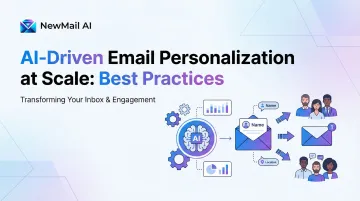
If you're sending outbound emails in 2026, you already know the traditional approach is broken. Professionals receive an average of 121 emails daily, and the standard tactic of dropping a first name or company into a template no longer moves the needle. Decision-makers can spot a mail-merge from across the room, and average cold email reply rates have plummeted to between 3.1% and 3.43% as a result.
The performance gap between generic outreach and truly personalized emails tells a different story. Signal-based personalization drives reply rates of 15–30% — up to ten times the baseline — while advanced AI personalization doubles reply rates and lifts open rates by 10% compared to standard templates.
AI has shifted how personalization works, but not in the way most guides suggest. This article covers what actually moves the needle: layering signal-based context with authentic voice matching, scaling without sacrificing quality on your highest-value outreach, and the one topic most resources skip — how to handle privacy when AI touches your inbox.
Key Takeaways
- AI personalization means contextual, voice-matched, timely outreach — not just {{first_name}}
- Layer signal-based context with your authentic tone for the best results
- Use a tiered approach to scale without sacrificing quality on key contacts
- Privacy and data handling are core to responsible AI personalization, not an afterthought
Why Generic Email Personalization No Longer Works
Traditional mail-merge personalization — swapping a name, company, or job title into a fixed template — has become transparent to modern recipients. When professionals manage over a quarter of their workweek sorting through roughly 120 emails daily, they develop pattern recognition quickly. The structure of templated outreach is instantly recognizable, which erodes trust and tanks response rates.
The numbers confirm the saturation problem:
- Average cold email reply rates have compressed to 3.1-3.43% across platforms
- Reply rates dropped from 6.8% in 2023 to 5.8% in 2025, even as personalization tools proliferated
- Volume-based strategies fail because the inbox is mathematically oversaturated
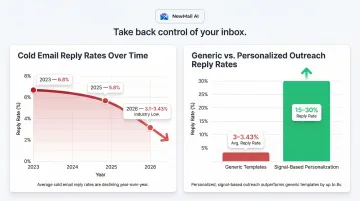
Those numbers point to a deeper problem than volume. The critical distinction is between superficial personalization — variables swapped into a template — and true personalization — messaging that reflects genuine understanding of the recipient's context, challenges, or timing. Superficial personalization checks a box. True personalization answers the recipient's immediate question: "Why should I care about this message right now?"
That's precisely where AI-driven approaches close the gap. The right tools surface specific, verifiable context quickly — recent company developments, role changes, publicly stated challenges — then adapt tone and structure to match how a recipient actually communicates. The difference in output isn't subtle; it's the gap between a message that gets deleted and one that gets a reply.
5 Best Practices for AI-Driven Email Personalization at Scale
Effective AI personalization isn't a magic button. The teams seeing reply rates double or triple follow a consistent methodology. Here are the five practices that separate high-performing AI personalization from noise.
Best Practice 1: Ground Every Message in Real Context, Not Just Data Points
True personalization requires referencing something specific and verifiable about the recipient — a recent funding round, a product launch, a role change, a challenge they mentioned publicly. Generic industry pain points don't count.
AI tools excel at surfacing this context quickly, but the output quality depends entirely on the inputs you provide. Instead of asking AI to "write a sales email to a VP of Sales," feed it: "Write to Sarah Chen, VP of Sales at Acme Corp, referencing their Q4 earnings call where she mentioned struggles with rep productivity and quota attainment."
The difference is specificity. One precise, verifiable reference outperforms a message that tries to demonstrate you know everything about the recipient.
Best Practice 2: Match the Recipient's Communication Style
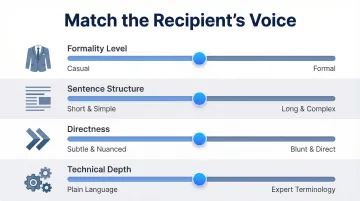
A formal executive requires different language than a startup founder. AI can analyze past email exchanges, LinkedIn activity, or public writing to calibrate the appropriate register, level of directness, and vocabulary for each recipient.
Key dimensions to match:
- Formality level — Does the recipient use contractions and casual language, or avoid them?
- Sentence structure — Short, punchy sentences or longer, detailed explanations?
- Directness — Do they get straight to the point, or prefer context before the ask?
- Technical depth — Industry jargon or plain language?
When your message mirrors how the recipient communicates, it feels less like outreach and more like a natural reply — not a cold interruption.
Best Practice 3: Personalize Timing, Not Just Content
Sending the right message at the wrong time kills even great personalization. AI helps identify trigger moments — a funding announcement, a job change, a product launch, a regulatory shift — when outreach feels relevant rather than random.
Examples of high-signal timing triggers:
- Role transitions — New VP of Sales hired; they're evaluating tech stack
- Funding events — Series B closed; budget unlocked for growth initiatives
- Company milestones — New product launch; they need supporting infrastructure
- Regulatory changes — Compliance deadline approaching; urgency is real
Contextual timing transforms a cold email into a timely offer of help.
Best Practice 4: Keep Personalization Specific and Concise
The "one strong hook" principle: one precise, verifiable reference outperforms a message that tries to prove you researched everything. Over-personalization (three personal facts, two company mentions, a recent social post) feels intrusive or performative.
Length is part of the precision. Emails between 50 and 125 words yield the highest response rates — approximately 50%, and messages under 80 words perform best in cold outreach. Emails with 3-4 sentences achieve the highest reply rates.
Keep AI-generated emails to 50-100 words: one strong hook, one clear value point, one specific call to action.
Best Practice 5: Build a Testing and Iteration Loop
AI personalization improves over time only if you track which types of personalization produce better outcomes for your specific audience. Establish a basic loop:
- Segment campaigns by personalization type — timing-based, context-based, or tone-based
- Track reply rates by segment to isolate which variable is moving the needle
- Spot patterns — which hooks, tones, or triggers resonate most with your ICP
- Adjust your AI inputs — update prompts, data sources, and tone settings to reflect what works
Each campaign gives you sharper signal. Teams that close this loop consistently see personalization quality compound — not plateau.
How AI Helps You Personalize in Your Authentic Voice
When email volume scales up, there's a real risk that AI-generated messages start to sound generic, robotic, or inconsistent with your actual communication style. The best AI email tools solve this by learning your voice — not just inserting data, but mimicking tone, vocabulary, sentence rhythm, and typical sign-off style.
What "Writing in Your Voice" Actually Means
Voice matching requires the AI to analyze real examples of how you communicate. To get this right, the AI needs to understand:
- Your formality level — contractions and casual openers vs. structured, formal tone
- How you start emails — with a question, an observation, or straight to the point
- Phrases and vocabulary you actually use — not generic filler
- Your typical structure — short and punchy, or context-first before the ask
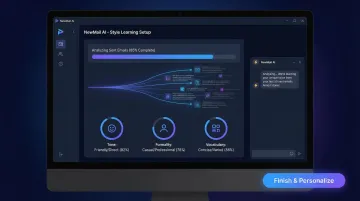
The output should be indistinguishable from something you would have written yourself. NewMail AI handles this by analyzing your sent emails and learning your communication style in 60 seconds, so every AI-drafted reply or outbound message sounds like you, not a template.
Why Voice Consistency Matters More at Scale
When you're personalizing dozens or hundreds of emails, voice consistency becomes the thing that makes your outreach feel like a coherent identity rather than a patchwork of different voices. Recipients who receive multiple emails from you over time should hear the same tone, the same personality.
Inconsistent voice erodes trust. If your first email is warm and conversational but your follow-up is stiff and formal, the recipient notices — and disengages.
The Human Review Step
Even with strong voice matching, a brief review before sending catches errors, outdated context, or tone mismatches. Best practices for building a lightweight review process:
- Scan for factual accuracy — verify names, companies, recent events (10 seconds)
- Check tone appropriateness — does this match the relationship stage?
- Confirm the ask is clear — is the call to action specific and easy?
This review doesn't need to be a bottleneck. A 10-15 second check per email prevents the rare but relationship-killing error while maintaining speed at scale.
A Tiered Approach to Personalizing at Scale
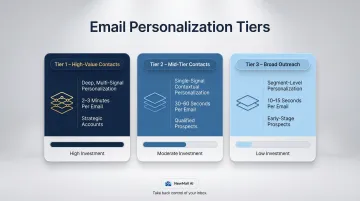
Not every email on your list deserves — or requires — the same depth of personalization. A simple three-tier model makes AI personalization scalable:
Tier 1: High-Value Contacts (Deep, Multi-Signal Personalization)
Strategic accounts, executive relationships, high deal value, and customers at renewal belong here. Personalization goes deep:
- Reference a specific recent development — funding round, product launch, hiring announcement
- Calibrate tone fully to the recipient's communication style
- Mention a mutual connection or shared context where relevant
- Tailor the value proposition to their stated priorities
Time investment: 2-3 minutes per email (AI drafts, you refine and verify)
Tier 2: Mid-Tier Contacts (Single-Signal, Contextual Personalization)
Qualified prospects and warm leads who match your ICP but aren't strategic accounts. Personalization stays efficient:
- Open with one relevant observation — an industry trend, company milestone, or role-based challenge
- Use a semi-customized tone with a standard body structure
- Tailor the call to action to their specific context
Time investment: 30-60 seconds per email (AI drafts, you review)
Tier 3: Broad Outreach (Segment-Level Personalization)
Early-stage prospects and large-volume campaigns. Personalization operates at the segment level:
- Adjust the opening line and pain-point framing by industry or role
- Maintain consistent tone and structure across the batch
- Prioritize relevance to the segment over individual customization
Time investment: 10-15 seconds per email (AI generates, you spot-check)
Segment-level messaging consistently outperforms generic templates — recipients respond to emails that reflect their context, even when the customization isn't individual.
How to Decide Contact Tier
Four inputs determine where a contact belongs:
- ICP fit — how closely the contact matches your ideal customer profile
- Relationship history — whether you have an existing relationship, prior engagement, or a cold starting point
- Deal size or strategic value — revenue potential and account importance
- Signal availability — the volume and recency of specific context you can reference
AI can score and sort contacts against these criteria automatically, turning tier assignment into a background process rather than a manual decision.
Privacy-First AI Personalization: The Best Practice Most Guides Skip
AI personalization requires feeding the tool information about recipients — past emails, behavioral data, company context. This raises real questions: Where does that data go? Who can access it? How long is it retained?
Most personalization guides ignore this entirely. But for professionals in regulated industries — legal, finance, healthcare — or anyone handling confidential communications, it's not optional.
What to Look for in an AI Email Tool from a Privacy Standpoint
Before any AI tool touches your inbox, ask these five questions:
- Where is data processed? On-device, in your region, or distributed globally?
- Is email content stored after drafting? Ephemeral processing (immediate discard) is the gold standard.
- Does the provider hold Zero Data Retention agreements with underlying AI models? This prevents your data from training public models.
- Is the tool GDPR-compliant? Critical if you operate in the EU or Switzerland.
- What encryption standard applies? AES-256 for data at rest and in transit should be the baseline.
NewMail AI was built with privacy as its architecture, not a feature — with ephemeral data processing, Zero Data Retention agreements with AI providers including Anthropic and Mistral, and Swiss-made infrastructure under some of the world's strictest data protection laws. The platform never stores email content; emails pass through momentarily for processing, then are immediately deleted.
Zero Data Retention Explained
Zero Data Retention (ZDR) means that AI providers discard all inputs immediately after processing — no logging, no storage, no secondary use. OpenAI's Enterprise API offers ZDR for eligible customers, and Microsoft 365 Copilot does not use prompts or responses to train foundation models.
For enterprise procurement, ZDR is a critical privacy control. It ensures your confidential emails never become training data for public AI models. Major incidents — Samsung banned ChatGPT after employees uploaded source code, JPMorgan restricted use due to compliance concerns — highlight the risks of unvetted AI tools.
The Reputational Dimension
Recipients are increasingly aware of AI-generated outreach, and there's growing scrutiny around how senders collect and use personal data to fuel personalization. Responsible personalization — using only publicly available or consensually shared context — builds trust rather than eroding it.
That trust erodes quickly when the sourcing is questionable. Scraping LinkedIn profiles, purchasing intent data from third-party brokers, or running "shadow AI" tools without clear data governance creates both reputational and legal exposure.
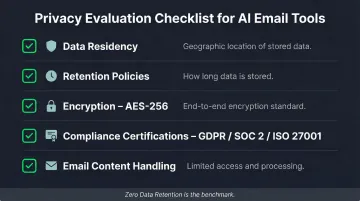
Privacy Evaluation Checklist
Before adopting an AI personalization tool, verify:
- Data residency: Confirm the jurisdiction. EU/Swiss-based processing carries stronger legal protections than globally distributed alternatives.
- Retention policies: Zero retention is the benchmark — anything longer requires a clear justification and contractual commitment.
- Encryption: AES-256 for data at rest and in transit is the current industry standard.
- Compliance certifications: GDPR compliance is the floor; SOC 2 and ISO 27001 indicate mature security practices.
- Email content handling: Verify whether the tool stores email content at all, or discards it immediately post-processing.
Common AI Email Personalization Mistakes to Avoid
The Over-Personalization Trap
Referencing too many details in one email — three personal facts, two company mentions, a recent social post — feels intrusive or performative. One well-chosen, specific reference almost always outperforms a message that tries to demonstrate deep research in every sentence.
Example of over-personalization: "Hi Sarah, I saw you just joined Acme Corp as VP of Sales, congratulations! I also noticed you posted about sales productivity challenges on LinkedIn last week, and I read your recent interview in SalesTech Monthly where you mentioned struggling with quota attainment. By the way, I went to the same university as your CFO..."
Better approach: "Hi Sarah, congratulations on joining Acme as VP of Sales. I saw your recent LinkedIn post about sales productivity challenges — that resonated because we help teams like yours close that exact gap. Worth a quick conversation?"
The Hallucination Risk
AI tools can generate plausible-sounding but factually incorrect statements about a recipient or their company. Documented examples include AI congratulating prospects on funding rounds that never happened, referencing blog posts they didn't write, or naming products they don't sell.
In 2024, Air Canada was held liable after its chatbot hallucinated a fake refund policy. In legal contexts, LLMs hallucinate between 69% and 88% on specific queries, leading to over 120 documented cases of fabricated citations in court filings.
Spot-check AI-generated context before sending, especially for high-value outreach. A single factual error can permanently damage a relationship — and with senior prospects, there's rarely a second chance to correct it.
Skipping Voice Calibration
Accuracy matters less if the email doesn't sound like you. Using an AI tool with default settings produces output that sounds like everyone else using that tool — and without teaching it your tone and style upfront, generic voice undermines whatever personalization you've added.
Spend 5-10 minutes feeding the AI examples of your best emails, specifying your preferred formality level, typical opening/closing structure, and tone. Many tools — including NewMail AI — automate this by analyzing your sent emails in under 60 seconds.
Frequently Asked Questions
How do you use AI for email personalization at scale?
AI email personalization at scale works by having the AI analyze recipient context (role, company signals, communication history), generate tailored message content, and adapt to your voice — enabling high-quality, individualized emails to be produced in seconds rather than minutes per recipient. The key is feeding the AI quality inputs and maintaining a lightweight review process.
Can AI-driven email personalization tools improve outbound messaging?
Yes. AI improves outbound by surfacing timely context (trigger events, role changes, company news), matching message tone to the recipient, and reducing the research burden that prevents most teams from personalizing every email. This results in meaningfully higher reply rates — often 2-3x higher — compared to generic templates.
What is the 80/20 rule in email marketing?
The 80/20 rule suggests 80% of your content should deliver genuine value to the recipient (insights, relevance, help) and only 20% should be promotional or focused on your offer. This principle, derived from the Pareto Principle, keeps AI-personalized messages recipient-centric rather than product-first.
What is the 30/30/50 rule for cold emails?
The 30/30/50 framework divides cold email effort into 30% targeting and list research, 30% messaging and personalization, and 50% follow-up strategy. AI can accelerate the 30% personalization portion — traditionally the most time-consuming — by generating tailored openings at scale.
What is the 60/40 rule in email?
The 60/40 rule has two interpretations: keeping 60% of email as text and 40% as visuals to avoid spam filters, or — more practically — spending 60% of effort on audience targeting and 40% on message crafting. Either framing reinforces context-first personalization over message-first outreach.