Introduction
The sales development function has changed faster in the past two years than in the previous decade. AI SDR platforms now handle prospect research, personalized outreach, follow-up sequencing, and meeting booking at a scale no human team can match—making them a core layer of any serious marketing automation strategy.
According to MarketsandMarkets, the AI SDR market was valued at $2.88 billion in 2024 and is projected to reach $15.01 billion by 2030, growing at a 29.5% CAGR. But rapid adoption has a downside — pick the wrong platform and you'll burn through your prospect list with generic outreach that damages your brand before a single meeting is booked.
Here's what this guide covers:
- What AI SDR marketing automation actually does (and how it differs from traditional tools)
- Reviews of the top 5 platforms in 2026
- A clear framework for choosing the right one based on your sales motion, budget, and compliance needs
TL;DR
- AI SDR tools automate the entire top-of-funnel workflow—prospect research, personalized outreach, follow-up sequences, and meeting booking—without manual rep involvement.
- Top platforms in 2026 differentiate on signal quality, personalization depth, deliverability infrastructure, and CRM integration.
- Tools covered: Apollo.io, Artisan (Ava), Instantly, AiSDR, and Qualified (Piper).
- Choose based on your sales motion (inbound vs. outbound), team size, tech stack, and data privacy requirements.
- Once AI SDR campaigns generate replies, managing those responses at speed requires an inbox-native AI assistant—NewMail AI handles that layer.
What Is Marketing Automation in AI SDR?
AI SDR marketing automation is software that uses AI to execute the sales development workflow—identifying prospects, researching accounts, generating personalized outreach, managing follow-up sequences, and booking meetings—without requiring a human rep at each step.
How It Differs from Traditional Marketing Automation
Traditional tools like HubSpot or Marketo automate sending to a fixed list using pre-built workflows. AI SDR platforms go further:
- Dynamic prospect research — the AI identifies and enriches prospects in real time
- Buying signal detection — job changes, funding rounds, and tech stack shifts trigger outreach automatically
- Prospect-specific messaging — each email references something specific and current about that prospect
- Autonomous follow-up — the platform manages multi-step sequences without human scheduling
The result is outreach that lands when it's actually relevant, shaped around what's happening with that prospect right now.
The Four Core Components
Every AI SDR marketing automation stack covers some combination of these layers:
- Signal detection and prospect identification — surfacing accounts showing active buying intent, not just accounts that fit a persona
- AI-generated personalized messaging — drafting outreach that references recent news, role changes, or company events specific to that prospect
- Multi-channel sequence management — coordinating email, LinkedIn, and phone touchpoints across a single connected sequence
- Reply handling and meeting booking — routing responses and converting interest into scheduled calls without manual handoffs
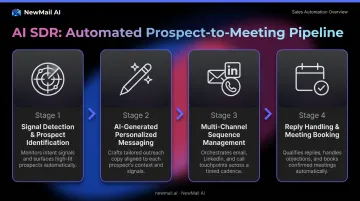
The tools reviewed below cover different parts of this stack. A few handle all four layers autonomously; others are purpose-built for one or two and integrate with the rest.
Top 5 Best AI SDR Software for Marketing Automation in 2026
Tools were selected based on feature depth, user-reported performance, pricing transparency, integration ecosystem, and suitability for different team sizes and sales motions.
Apollo.io
Apollo.io combines a 230M+ verified contact database with built-in AI sequencing, a dialer, and email automation. For teams new to AI SDR marketing automation, it's one of the most accessible entry points available. ICP targeting filters, buyer intent signals, and a free tier make it the practical choice for early-stage startups and SMBs that need prospecting data and outreach tools without juggling multiple vendors.
Apollo holds a 4.7/5 rating across 9,675 G2 reviews, reflecting broad user satisfaction at scale.
| Feature | Details |
|---|---|
| Key Features | B2B database (230M+ contacts), AI-enhanced ICP filters, intent signal capture, built-in email sequencing, CRM integrations, dialer |
| Pricing | Free tier available; paid plans available (verify current pricing at apollo.io/pricing) |
| Best For | Early-stage startups and SMBs needing an all-in-one prospecting and outreach platform at an accessible price |
Artisan (Ava)
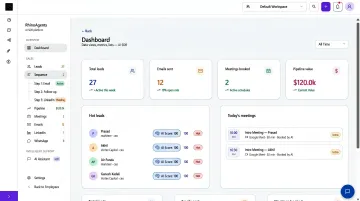
Artisan's AI SDR agent, Ava, handles prospect discovery, data enrichment, personalized email generation, and multi-step sequence management without requiring human intervention at each step. It functions as a fully autonomous outbound SDR.
What sets Ava apart is its dual operating mode: autopilot (fully automated sending) and co-pilot (human review before each message goes out). Its built-in scoring system prioritizes outreach using firmographic, technographic, and hiring signals, eliminating the need to stitch together separate data vendors. Artisan raised a $25M Series A in April 2025.
Vendor-published case studies report notable results (3.6% positive reply rate for SaaStr; $52 cost per lead for SumUp after 400,000+ emails), though these figures are self-reported and should be verified against your own pilot data.
| Feature | Details |
|---|---|
| Key Features | Autonomous AI SDR agent, built-in lead scraping, technographic/firmographic/hiring signal scoring, autopilot and co-pilot modes, email personalization |
| Pricing | Free, Intern ($250/mo), Employee ($600/mo) — billed annually; verify current pricing at artisan.co/pricing |
| Best For | Teams wanting an all-in-one autonomous AI SDR that bundles data, signals, and outreach |
Instantly
Instantly is built around the one thing most AI SDR tools neglect: deliverability. Unlimited sending accounts, automated inbox warming, and domain reputation monitoring are core features, not add-ons.
The platform monitors 94 blacklists and checks SPF, DKIM, and DMARC across providers including Gmail and Outlook. Its Hypergrowth plan supports 100,000 emails per month; enterprise tiers reach 500,000+. For teams whose primary risk is landing in spam rather than writing the wrong message, Instantly addresses the layer that matters most.
G2 rates Instantly at 4.8/5 across 4,121 reviews—the highest satisfaction score among the five platforms covered here.
| Feature | Details |
|---|---|
| Key Features | Unlimited sending accounts, automated inbox warming, domain reputation monitoring, AI sequence builder, sending volume controls, analytics |
| Pricing | Outreach Growth starts at $47/month; bundle plans from $94/month; verify current pricing at instantly.ai/pricing |
| Best For | Teams prioritizing deliverability at high email volume; email-first outbound motions |
AiSDR
AiSDR differentiates on two fronts: a conversational messaging style and pricing published openly on its website, no demo call required. That transparency alone separates it from most enterprise-focused competitors.
Rather than scripted sequence templates, AiSDR generates outreach that mimics natural, multi-turn conversation. It also handles basic reply management—the AI can respond to prospect replies and keep conversations moving until a meeting is booked. AiSDR claims an average 1–3% conversion rate from cold prospect to booked meeting (vendor-published figure; treat as directional).
| Feature | Details |
|---|---|
| Key Features | AI email + LinkedIn outreach, conversational messaging AI, basic reply management, sequence automation, analytics |
| Pricing | Solo $250/mo; Explore $900/mo; Scale $2,500/mo — annual billing provides 20% discount; quarterly commitment required for Explore and Scale |
| Best For | SMBs and startups wanting predictable pricing, fast setup, and conversational AI outreach |
Qualified (Piper)
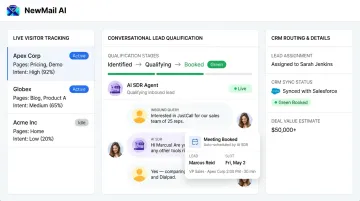
While every other tool on this list focuses on outbound, Qualified's AI SDR agent Piper works the inbound side: converting website visitors before they go cold. Piper engages visitors in real time, asks qualifying questions, routes high-intent buyers to the right rep, and books meetings instantly without human intervention.
Its native Salesforce integration is a genuine differentiator. Piper uses live CRM data to personalize conversations, identify known accounts, and route leads based on account ownership rules. Qualified holds a 4.9/5 rating across 1,495 G2 reviews—the strongest trust signal in this comparison. Vendor-published case studies report Sinch uses Piper to perform the work of 13 human SDRs; Unisys reported a 200% increase in meetings booked.
Pricing is custom and enterprise-tier; Qualified does not publish dollar figures publicly. Verify current pricing directly with their team.
| Feature | Details |
|---|---|
| Key Features | Real-time website visitor engagement, conversational lead qualification, instant meeting booking, native Salesforce integration, lead scoring, intent signal tracking |
| Pricing | Custom enterprise pricing; Premier, Enterprise, and Ultimate plans available — contact Qualified directly |
| Best For | Mid-market and enterprise Salesforce-native teams with significant website traffic looking to convert inbound leads |
How to Choose the Right AI SDR Software
The Six Evaluation Dimensions
Tools were assessed across six areas. The most common buyer mistake is choosing based on demo quality rather than signal quality—signal quality is the single biggest predictor of real-world performance.
- Signal quality and data freshness — stale data produces irrelevant outreach regardless of how good the AI is
- Personalization depth — does the AI reference verifiable, real prospect context, or surface-level merge fields?
- Email deliverability infrastructure — can the platform maintain inbox placement at your target volume?
- CRM and stack integration — bidirectional sync, not just basic connectivity
- Pricing transparency — avoid platforms that require a sales call before showing basic pricing
- Brand safety controls — account exclusion lists, tone guardrails, and human review options
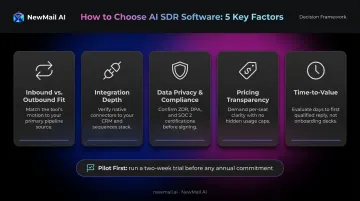
Five Factors That Should Drive Every Decision
- Inbound vs. outbound fit — match the tool to your sales motion before evaluating anything else. Piper for inbound; Apollo, Artisan, Instantly, or AiSDR for outbound.
- Integration depth — confirm bidirectional CRM sync and compatibility with your existing sales engagement platform.
- Data privacy and compliance — verify where prospect data is stored, which jurisdiction governs it, and whether the platform is GDPR-compliant. Note that platform-level compliance varies significantly even among vendors that claim GDPR readiness.
- Pricing model transparency — platforms that hide pricing behind demo calls make budgeting and comparison difficult.
- Time-to-value — ask vendors for realistic setup timelines and insist on a 30-day controlled pilot with real ICP data before committing to an annual contract.
The Brand Safety Risk Nobody Talks About
One factor that rarely comes up in demos: brand safety. At high outreach volumes, an AI SDR sending a pitch to an existing customer — or a prospect in a legally sensitive situation — can cause real damage. Ask every vendor specifically:
- Does the platform support account exclusion lists?
- Are tone guardrails configurable?
- Is human review available before messages send?
Vendors who can't answer all three clearly aren't ready for production use at scale.
Conclusion
The right AI SDR tool produces meetings and pipeline. The wrong one produces volume—and a damaged sender reputation that takes months to recover. Match your selection to your sales motion (inbound or outbound), verify integration depth with your existing stack, and prioritize signal quality over demo polish.
Run a 30-day controlled pilot with real ICP data before signing any annual contract. Measure success on meetings booked and pipeline generated—not emails sent.
Once AI SDR campaigns start driving replies, the next challenge is managing those conversations at scale without missing hot leads. That's the problem NewMail AI is built to solve. Working natively inside Gmail, Outlook, and Apple Mail, it helps sales and customer success teams handle inbound reply volume without letting hot leads slip through:
- Prioritizes inbound replies by intent so high-value responses surface first
- Drafts context-aware responses in your voice, ready for one-click review
- Surfaces stalled conversations before they go cold
Every draft requires your explicit approval before sending. Combined with Zero Data Retention and Google's highest-tier security certification, NewMail AI keeps human judgment in the loop without slowing you down.
Try NewMail AI free for 14 days—no credit card, no download, setup in under 3 minutes at app.newmail.ai.
Frequently Asked Questions
What is the best AI software for marketing?
The right platform depends on your use case. For outbound prospecting and email automation, Apollo.io and Instantly lead the market. For inbound lead qualification, Qualified (Piper) is the strongest choice. Teams wanting an all-in-one autonomous agent should look at Artisan (Ava) and AiSDR, both well-regarded in 2026.
What is the difference between an AI SDR and a traditional marketing automation tool?
Traditional tools like HubSpot and Marketo automate sending to pre-built lists using fixed workflows. AI SDR tools go further—they dynamically research prospects, detect real-time buying signals (job changes, funding rounds), generate personalized messages grounded in those signals, and autonomously manage multi-step sequences and replies.
Can AI SDR tools replace human sales reps?
AI SDR tools excel at prospecting, email personalization, and follow-up scheduling—but human reps still outperform them on objection handling and enterprise relationship building. According to Salesforce's 2026 State of Sales report, 87% of sales organizations use some form of AI. The highest-ROI model is hybrid: AI at the top of funnel, humans managing responses and deal closure.
What should I look for when choosing an AI SDR tool?
Prioritize these five criteria before committing:
- Signal quality and data freshness
- Personalization depth beyond template merge fields
- Email deliverability infrastructure
- Bidirectional CRM integration
- Pricing transparency
Require a 30-day controlled pilot with real ICP data before signing any annual contract.
How much do AI SDR platforms typically cost?
Instantly starts at $47/month; AiSDR ranges from $250–$2,500/month; Artisan's plans start at $250/month (billed annually); Qualified uses custom enterprise pricing with no public figures. Price does not correlate with performance—evaluate each tool against your specific use case and verify current pricing directly with vendors.
How do AI SDR tools handle email privacy and data compliance?
Compliance standards vary by platform and jurisdiction. Teams under GDPR should verify data storage practices, applicable protection laws, and whether Zero Data Retention options exist. Prioritize vendors with published certifications (SOC 2 Type II, GDPR attestations) and clear data processing agreements—and confirm your AI email assistant meets the same standards as the SDR platform itself.