Introduction
Sales development is a numbers game built on repetitive work — and that repetition is expensive. According to HubSpot's 2026 sales statistics, reps spend only 2 hours per day on active selling, with another hour consumed by administrative tasks. Meanwhile, 80% of successful sales require 5+ follow-ups, yet 44% of salespeople quit after the first attempt.
The business cost is real: SDR median OTE sits at $85,000, and only 27% of reps consistently hit quota. Teams are paying full salary for a fraction of productive output.
AI SDR agent software has matured enough to close that gap. The tools available in 2026 handle prospecting, outreach drafting, follow-up sequences, reply handling, and meeting booking — with varying degrees of automation and human oversight depending on how your team wants to operate. This guide breaks down six leading platforms across the criteria that actually matter: capability depth, integration fit, and total cost of ownership.
TL;DR
- AI SDR agents automate the top-of-funnel tasks that drain human reps: prospecting, personalized outreach, follow-ups, and meeting booking
- The 2026 market splits between fully autonomous outbound agents (11x.ai, Artisan) and AI-assisted sequencing platforms (Reply.io, AiSDR)
- Matching tool type to your workflow gap matters more than chasing features
- Evaluate tools on autonomy level, CRM integration depth, personalization quality, compliance posture, and pricing transparency
- NewMail AI is an inbox-native alternative for teams that need privacy-compliant AI email drafting, built on zero data retention
- Verify all pricing directly with vendors before purchasing (figures in this guide reflect publicly available data as of 2026)
What Are AI SDR Agents and What Tasks Can They Automate?
True AI Agents vs. Automation Scripts
Not everything marketed as an "AI SDR" qualifies as one. The distinction matters when evaluating tools.
A true AI agent — as IBM and McKinsey define them — autonomously plans and executes tasks, adapts based on context, and handles situations it wasn't explicitly pre-programmed for. A rule-based automation script follows fixed templates on a schedule. It sends email #3 on day 7 regardless of whether the prospect replied on day 4.
Most platforms on the market sit somewhere between these two extremes. The best ones adapt based on context — not just the calendar. Understanding where a tool falls on that spectrum should drive your evaluation.
Core SDR Tasks These Tools Can Automate
The full automatable SDR workflow includes:
- Prospect research and list building based on ICP criteria
- Personalized outreach drafting using contextual signals, not static templates
- Multi-step follow-up sequences with adaptive timing
- Reply handling and objection responses at scale
- Lead qualification based on responses and intent data
- Meeting scheduling with calendar integration and automated booking
- CRM data entry — logging contacts, activity, and notes automatically
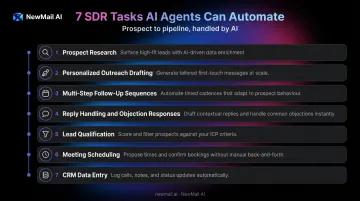
The most advanced tools handle this entire cycle. Most specialize in a subset, so matching tool capabilities to your team's workflow gaps is the real buying decision.
Why 2026 Is the Inflection Point
Grand View Research pegs the AI SDR market at $3.85 billion in 2024, projected to reach $32.23 billion by 2033 at a 26.7% CAGR. Gartner reports that sales organizations using AI-enabled next best actions are 2.6x more likely to achieve commercial growth. The firm also predicts 95% of seller research workflows will start with AI by 2027, up from less than 20% in 2024.
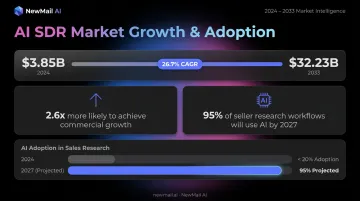
At that adoption rate, teams still running fully manual SDR workflows by 2027 will be competing against organizations operating at materially higher throughput — with the same headcount.
Best AI Agent Software for SDR Task Automation in 2026
Tools were selected based on five criteria: automation depth, personalization quality, CRM integration, pricing transparency, and real-world performance across B2B outbound and email use cases.
Agent Frank by Salesforge
Agent Frank is an adaptive AI SDR built for teams that want outbound automation without abandoning control. It operates in two distinct modes: Autopilot (fully autonomous outbound) and Co-Pilot (human reviews before messages send). This dual-mode design makes it one of the more flexible options for teams transitioning from manual sequences to autonomous outreach.
Key differentiators include ICP-based prospect list building, adaptive learning from response patterns, seamless mailbox warm-up, and multi-calendar integration for automated meeting booking. According to Salesforge's official page, 1,000 active contacts can translate to 2,000–2,500 new leads and 6,000–7,500 personalized emails per month.
| Feature | Details |
|---|---|
| Key Features | Dual autopilot/co-pilot modes, ICP-based prospect list building, adaptive learning from response data, multi-calendar scheduling, CRM data sync |
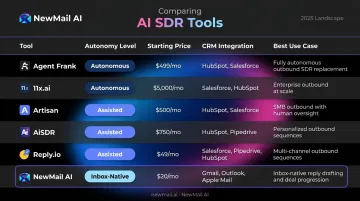
| Pricing | $499/month billed annually or $599/month billed quarterly for 1,000 active contacts — verify at salesforge.ai |
| G2 Rating | 4.6/5 (118 reviews for Salesforge) |
| Best For | Sales teams wanting a scalable AI SDR that adapts to their sales style without a full technical overhaul |
11x.ai (Alice)
Alice is positioned as a fully autonomous outbound SDR designed to own the entire top-of-funnel workflow with minimal human involvement once configured. It handles ICP building, prospect research, intent-driven personalized outreach, 24/7 follow-up, CRM data entry, and intent tracking.
Vendor-reported performance claims include a 30% increase in meetings per AE and 50% reduction in cost-per-lead. Factor in a 2–4 week setup ramp and pricing that starts at $36,000/year — budget and TAM size should clear a high bar before committing.
| Feature | Details |
|---|---|
| Key Features | Fully autonomous outbound, multichannel engagement (email + LinkedIn), intent-signal personalization, intent tracking, automated CRM updates |
| Pricing | Growth plan starts at $3,750/month ($36,000/year); Pro and Enterprise are custom — verify at 11x.ai |
| G2 Rating | Not publicly listed — verify at g2.com |
| Best For | Mid-market and enterprise B2B teams with large TAM, a defined ICP, and budget to replace or supplement SDR headcount |
Artisan (Ava)
Ava combines a 250M+ verified B2B contact database across 200+ countries with autonomous prospecting, personalized email outreach, LinkedIn messaging, and follow-ups in a single platform. It removes the need to stitch together separate data and sequencing tools.
Differentiators include waterfall enrichment across 22+ data sources, intent-signal personalization (job changes, funding rounds, LinkedIn activity), and A/B testing automation. Note that G2 reviews are mixed — some users praise automation quality, while others report messaging that feels generic or obviously AI-generated. Data coverage is strongest in the US market.
| Feature | Details |
|---|---|
| Key Features | 250M+ contact database, multichannel outreach (email + LinkedIn), intent-signal personalization, autopilot and human-in-the-loop modes, A/B testing automation |
| Pricing | Intern plan ~$250/month (billed annually); Employee plan ~$600/month — verify at artisan.co |
| G2 Rating | 4.0/5 (26 reviews) |
| Best For | B2B outbound teams wanting a combined data + multichannel outreach agent without managing multiple separate tools |
AiSDR
AiSDR is a fully autonomous email-first SDR platform that handles both inbound qualification (responding to form fills and demo requests) and outbound prospecting. Its published pricing is a genuine differentiator in a category where most enterprise tools require a sales call to get a number.
Deep bidirectional HubSpot integration is the standout feature — AiSDR personalizes outreach using existing CRM data, meaning prospects receive outreach informed by their actual history with your team. The platform also connects to Salesforce and accesses a 300M+ global lead database. Note the quarterly contract requirement and that LinkedIn outreach is not included on base plans.
| Feature | Details |
|---|---|
| Key Features | Autonomous inbound + outbound SDR, 300M+ lead database, email and text automation, native two-way HubSpot and Salesforce sync, intent-based lead qualification |
| Pricing | Solo $250/month; Explore $900/month; Scale $2,500/month — all on quarterly contracts; verify at aisdr.com |
| G2 Rating | 4.6/5 (98 reviews) |
| Best For | Teams using HubSpot as their CRM that want transparent pricing and autonomous handling of both inbound and outbound email |
Reply.io (Jason AI)
Reply.io is a mature multichannel outbound platform with Jason, its AI agent, layered on top. It covers email, LinkedIn, SMS, WhatsApp, and calls within AI-assisted sequences — humans design the workflow, and Jason personalizes and executes at scale.
The most accessible price point on this list makes it the logical starting point for teams not ready to commit to fully autonomous platforms. Built-in deliverability warm-up and thorough documentation reduce implementation risk. The key caveat: this is AI-assisted, not autonomous — someone on your team must define and manage sequences.
| Feature | Details |
|---|---|
| Key Features | AI-generated outbound emails and LinkedIn messages, multichannel sequencing (email, LinkedIn, SMS, WhatsApp, calls), calendar-based meeting booking, deliverability controls, CRM integrations |
| Pricing | Email Volume from $49/user/month (billed annually); Jason AI SDR from $500/month — verify at reply.io |
| G2 Rating | 4.6/5 |
| Best For | Teams with an existing prospect list that want AI-enhanced personalization and multichannel reach without committing to a fully autonomous platform |
NewMail AI
NewMail AI occupies a distinct position in this list: it's not an outbound prospecting engine. It's a privacy-first AI email assistant built for SDR teams and sales professionals managing high reply volumes, drafting personalized follow-ups, and extracting action items from prospect meetings — operating natively inside Gmail, Outlook, and Apple Mail.
Where outbound agents like Alice or Ava generate new pipeline, NewMail AI handles what happens after the conversation starts. Its AI assistant, Nova, learns each rep's voice and style in approximately 60 seconds and drafts replies that match the rep's tone and phrasing. Priority inbox with custom categories surfaces the most important inbound threads first, so a hot prospect reply doesn't get buried under low-priority noise.
For compliance-sensitive environments, the architecture matters. NewMail is Google Security Certified at the highest tier, Swiss-made and GDPR compliant, with Zero Data Retention agreements with AI providers including Anthropic and Mistral. Email content is analyzed in memory and immediately discarded — never written to disk or retained on NewMail's servers.
Every AI-drafted email requires explicit rep approval before sending, maintaining a clear human-in-the-loop accountability chain.
Setup takes under 2 minutes via OAuth connect — no IT configuration, no new dashboard to learn, no credit card required for the free trial.
| Feature | Details |
|---|---|
| Key Features | AI email drafting in your voice, priority inbox with custom categories, task extraction and follow-up automation, meeting recap with action items, works inside Gmail/Outlook/Apple Mail, zero data retention architecture |
| Pricing | Free 2-week trial (no credit card); Professional plan from $12/month; Enterprise plans for teams of 20–200+ — visit newmail.ai for current pricing |
| Best For | SDR teams and sales professionals in privacy-sensitive industries who need AI-powered inbox management and email drafting without storing or exposing email data |
How We Selected These AI SDR Tools
Tools were evaluated against five criteria that directly affect real-world SDR outcomes:
- Automation depth and autonomy level — does the tool execute, or just suggest?
- Personalization quality — context-driven responses vs. static template insertion
- CRM and calendar integration reliability — bidirectional sync, not just one-way logging
- Data security and compliance posture — ZDR, DPA, GDPR, and certification status
- Pricing transparency and scalability — can you evaluate cost without a demo call?
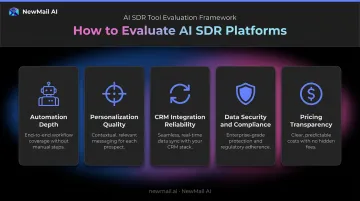
The most common evaluation mistake is judging AI SDR platforms on automation volume or dashboard aesthetics rather than qualification accuracy and conversion outcomes. A tool that blasts irrelevant emails at scale does more damage than good. Always pilot with your own ICP and real buyer questions before full rollout.
That ICP-fit test shapes what's included here. Tools were chosen to represent a range of use cases and budgets — from fully autonomous outbound agents for enterprise teams to privacy-first email management for compliance-sensitive environments — because workflow fit matters more than feature count.
Conclusion
The AI SDR tools market in 2026 spans a wide range: fully autonomous outbound agents, AI-assisted sequencing platforms, and inbox-native email management tools. The teams that see the best results pick the tool that closes their specific workflow gap — not the one with the longest feature list or the highest price tag.
Before committing, assess three things:
- Is your ICP and outbound messaging already tested manually? AI amplifies what works — it won't fix an undefined offer or unclear positioning
- Does the tool's data security posture meet your compliance requirements? This matters more in regulated industries and enterprise procurement
- Is the CRM and calendar integration bidirectional and structured? One-way logging misses most of the value
If that checklist points to inbox management as your gap — specifically high-volume follow-up, privacy-compliant AI drafting, and reply handling — NewMail AI is worth a look. It sets up in under 2 minutes inside Gmail, Outlook, or Apple Mail, retains zero email data, and offers a free trial so you can test it against your real inbox before committing.
Frequently Asked Questions
What are the best AI SDR tools?
The strongest options by use case:
- Agent Frank — adaptive autonomous outbound
- 11x.ai — high-volume autonomous prospecting
- Artisan — all-in-one multichannel prospecting
- Reply.io — accessible entry point for AI-enhanced sequencing
- NewMail AI — privacy-first inbox management and reply drafting
The right choice depends on whether your primary gap is outbound volume, inbound qualification, or inbox management.
Can you recommend AI roleplay software for SDRs?
AI roleplay for SDR training is a separate category from the tools covered in this guide. Platforms like Gong, Chorus by ZoomInfo, and Second Nature specialize in AI-powered sales coaching and roleplay simulations. The tools reviewed here focus on automating live SDR outreach and inbox tasks, not training workflows.
What tasks can AI SDR agents automate?
Core automatable tasks include:
- Prospect research and list building
- Personalized outreach drafting
- Multi-step follow-up sequences
- Reply handling and lead qualification
- Meeting scheduling and CRM data entry
The most advanced tools handle the full cycle; most platforms specialize in a subset.
Can AI SDR tools replace human SDRs completely?
AI SDR tools work best as augmentation, not replacement. They handle high-volume, repetitive top-of-funnel tasks so human reps can focus on complex discovery, objection handling, and relationship building. Research consistently shows that buyers still want human validation at key decision points — AI handles the volume work, humans close the deal.
How much do AI SDR tools cost in 2026?
Pricing ranges significantly by category: Reply.io starts from $49/user/month for sequences; AiSDR's Explore plan is $900/month; Artisan's Employee plan is approximately $600/month; and 11x.ai's Growth plan starts at $3,750/month. Always verify directly with vendors as pricing changes frequently.
What should I prioritize when choosing an AI SDR tool?
Start by defining your primary workflow gap — outbound volume, inbound qualification, or inbox management. Then evaluate:
- CRM integration depth — does it sync natively with your stack?
- Personalization quality — context-driven vs. template-driven output
- Data security posture — especially for regulated industries
- Autonomy level — does it match your team's readiness to reduce human oversight