Key Takeaways
- Responding to inbound leads within 5 minutes produces 8x higher conversion rates than waiting longer
- AI email agents go beyond filters — they read context, reason, act, and improve over time
- Sales teams get instant lead qualification; support teams offload repetitive tier-1 tickets to focus on complex cases
- Before deploying, verify zero data retention, ephemeral processing, and GDPR compliance
- Setup takes under 2 minutes with no IT involvement and no new platform to learn
Introduction
Most sales and support teams aren't losing deals or customers because of bad products. They're losing them because of slow replies.
A 2021 InsideSales study analyzing over 55 million sales activities found that conversion rates are 8x higher when inbound leads are engaged within 5 minutes, yet only 0.1% of leads actually receive a response that fast.
Support teams face the same pressure from the other direction. Zendesk's 2025 CX Trends report found that 88% of customers now expect faster response times than one year ago, with 74% expecting 24/7 availability.
The shared problem: email volume is relentless, repetitive tasks consume hours each day, and the messages that matter most — a hot inbound inquiry, an escalating complaint — can easily get buried.
This article covers specific AI email agent use cases for both sales and support teams: what they automate, what each team gains, and what to look for when choosing a solution your team can actually trust.
How AI Email Agents Work: Beyond Simple Automation
Filters Sort. Agents Think.
A traditional email filter checks whether a subject line contains a keyword, then moves the message to a folder — and stops there. An AI email agent reads the full message, understands what the sender actually wants, decides what should happen next, and acts without waiting for a human to trigger each step.
The distinction matters because most email complexity isn't in the routing. It's in the interpretation. A subject line that says "Quick question" could be a sales inquiry, a support complaint, or a vendor invoice. Only context resolves that — and context requires reading.
The Four-Stage Loop
Effective AI email agents operate through a continuous cycle:
- See — Read the full message and thread, extract intent, urgency, tone, and relevant signals
- Think — Reason about the right action using connected systems (CRM history, inbox rules, team context)
- Act — Execute: draft a reply, flag a thread, route to the right person, schedule a follow-up
- Learn — Improve from usage patterns and feedback, refining voice matching and prioritization over time
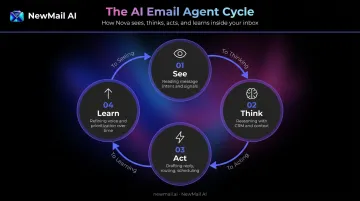
NewMail AI's Nova assistant follows this structure natively inside Gmail, Outlook, and Apple Mail. It categorizes emails based on conversation meaning rather than subject line keywords, tracks thread status (pending, stalled, active, completed), and drafts replies that match the sender's voice — all within the inbox the team already uses.
What an AI Agent Can Do Beyond Drafting
The four-stage loop enables a much wider action set than most teams expect when they first set up an AI email agent:
- Prioritize threads by urgency and stakeholder value automatically
- Extract tasks and action items from emails and link them to to-do lists
- Flag stalled conversations that have gone quiet mid-decision
- Stage escalation-ready context summaries so handoffs don't lose detail
- Trigger follow-up sequences based on inactivity rules the user controls
- Sort the inbox by workflow status without manual tagging
Nova operates on an approval-first model by design. Inbox sorting, prioritization, and flagging run automatically — but no email goes out without the user reviewing and approving the draft first. For sales and support teams handling sensitive communications, that human-in-the-loop control is non-negotiable.
AI Email Agent Use Cases for Sales Teams
The Response Window Problem
Sales emails don't age well. The same InsideSales research found that 57% of first contact attempts happen more than a week after the lead arrives. By that point, the prospect has either found a competitor or lost context entirely.
Closing that gap doesn't require more SDRs. It requires something that acts the moment a lead arrives, at any hour, in any time zone.
Inbound Lead Qualification and Instant First Response
When an inbound inquiry lands, an AI email agent processes it immediately:
- Extracts signals: company size cues, seniority language, stated need, urgency indicators
- Cross-references context: prior thread history, recent activity patterns
- Assesses fit: against configured qualification criteria
- Responds instantly: a personalized acknowledgment sent within seconds of arrival
From there, the agent applies split-path logic:
| Lead Tier | Action |
|---|---|
| High priority | CRM record flagged, rep notified, tailored follow-up staged |
| Mid priority | Relevant product information sent automatically |
| Disqualified | Polite redirect — no manual effort required |
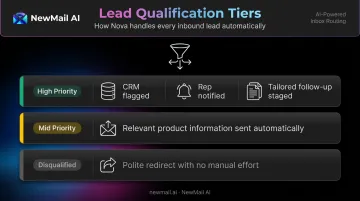
No lead falls through without action, regardless of when it arrives.
Follow-Up Sequences and Pipeline Nurturing
The follow-up gap is where most pipeline leaks. A rep sends a proposal, the prospect goes quiet, and three weeks later no one has followed up because everyone assumed someone else did.
AI agents fix this structurally:
- Stall detection surfaces threads that have gone quiet mid-decision
- Inactivity triggers send a follow-up automatically if no reply arrives within a set window (three days, for example)
- Post-demo emails go out minutes after a call ends, while context is fresh
- Pricing and FAQ questions are handled autonomously so reps don't break focus
What makes this work for high-value prospects is personalization. Nova learns a rep's writing style in 60 seconds during setup and continues improving with every interaction. Follow-up drafts reference conversation context, match the rep's tone, and include specific next steps rather than generic "just checking in" templates.
The practical result is a pipeline that runs without gaps: reps focus on warm conversations, CRM records stay current without manual entry, and no inbound lead sits unacknowledged at 11pm on a Friday.
That coverage matters even more when prospect data is sensitive. NewMail AI's architecture addresses this directly: no email content is stored, drafts are processed ephemerally, and the platform holds Google's highest-tier security certification, making it a viable choice for sales teams in regulated industries.
AI Email Agent Use Cases for Customer Support Teams
The Tier-1 Trap
A significant portion of support volume is structurally repetitive: password resets, order status checks, billing questions, refund policy explanations. These queries are easy to answer — but they arrive constantly, competing for the same human attention as complex escalations that actually require judgment.
Gartner predicts that by 2029, agentic AI will autonomously resolve 80% of common customer service issues without human intervention, reducing operational costs by 30%. That trajectory starts with removing the easiest tickets from the human queue today.
Tier-1 Ticket Resolution and FAQ Automation
When a support email arrives, an AI agent works through it systematically:
- Reads the full thread — not just the most recent message
- Identifies issue type: billing, access, feature question, complaint
- Assesses urgency and tone: frustrated customer vs. routine inquiry
- Drafts a resolution: complete, personalized, with relevant next steps
Categories well-suited to autonomous handling include:
- FAQ responses (refund policies, plan details, how features work)
- Initial acknowledgments that set response time expectations
- Reset and access redirect guidance
- Account status confirmations (where data access is configured)
The first-response time impact is significant. Automated replies reduce initial response from hours to under two minutes. That matters because most customers rate speed of acknowledgment more highly than depth of first response — getting a clear "we received this and here's what's happening" within minutes is itself a satisfaction driver.
Escalation Routing and Complex Case Handling
For tickets an AI agent can't resolve, the handoff is where many systems fail. A human agent receives an email, reads through a long thread, asks the customer to repeat information they've already provided, and starts from scratch.
A well-designed AI agent changes this:
- Summarizes the thread before routing: what the customer wants, what's been tried, what remains unresolved
- Pre-drafts a reply for the human agent to review and send
- Routes to the right person based on issue type or team structure
- Maintains 24/7 coverage with consistent response quality, even during off-hours or public holidays
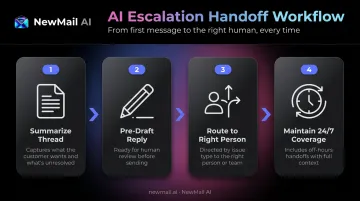
The human agent enters the conversation already informed. No repeated questions, no cold starts — just a faster path to resolution.
Teams using an approval-first drafting model (where AI prepares the response and a human sends it) get the speed benefit without losing accountability. That balance matters for support workflows where tone and accuracy carry real consequences.
Post-Sale and Customer Success Email Automation
The value of AI email agents doesn't stop when a deal closes. For customer success teams managing large account portfolios, the inbox becomes a signal layer — and most of those signals get missed.
Relevant use cases post-sale:
- Onboarding sequences triggered after a contract is signed, with check-in emails at defined intervals
- Renewal reminders surfaced ahead of contract dates without manual calendar tracking
- Expansion triggers based on account milestones or engagement patterns
- Proactive check-ins when a thread goes quiet after an unanswered question — before silence turns into churn
Nova's Conversation Stall Detection handles the last point automatically, flagging threads that have slowed or stopped so CSMs can intervene before the customer disengages entirely.
When a complex post-sale issue surfaces — a billing dispute or a technical escalation — Nova summarizes the full thread and stages context for whichever CSM picks it up. The customer gets continuity. The team gets speed.
For enterprise teams managing hundreds of accounts, that combination is what separates accounts that renew from accounts that quietly disappear.
Choosing an AI Email Agent Your Team Can Trust
It Should Live Where Your Team Already Works
The most effective AI email agents don't require a separate platform, a new dashboard, or a workflow migration. They work inside Gmail, Outlook, or Apple Mail — in the interface your team already opens every morning. When there's no behavior change required, adoption follows naturally.
NewMail AI's Nova deploys this way: connect your inbox, let the AI learn your context for 60 seconds, and your first draft is ready. Total setup is approximately two minutes, with no IT involvement for individual users.
Data Privacy Is Not Optional
Sales and support emails contain some of the most sensitive data in any organization: prospect details, client communications, pricing information, complaint histories. Before deploying any AI email agent, teams should verify:
- Zero data retention: email content is processed and discarded, never stored
- Ephemeral processing: data is handled in-memory only, with no persistent logs
- GDPR compliance: particularly important for European teams or those with EU customers
- Third-party AI provider agreements: does the vendor have formal ZDR contracts with the AI models they use?
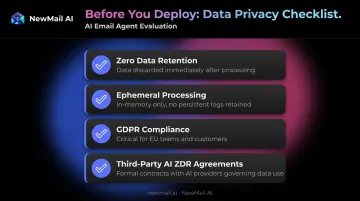
NewMail AI is headquartered in Switzerland under strict data laws, holds Google Security Certification at the highest tier, and has formal Zero Data Retention agreements with AI providers including Anthropic and Mistral. Email content is never logged or retained after processing. A Data Processing Agreement is available as a standard Enterprise feature.
For organizations in financial services, healthcare, or legal, this architecture matters structurally — not just as a marketing claim.
Three Additional Criteria to Evaluate
1. Voice and style matching Does the AI draft replies that sound like the sender, or do they read like a template? Tone consistency matters for both prospect trust and customer relationships. Nova learns writing style in approximately 60 seconds and improves continuously with use.
2. Setup speed Can the team be running in minutes without IT involvement? Tools that require complex configuration rarely achieve broad adoption.
3. Escalation logic Does the agent know when not to respond and route to a human instead? The best implementations define clear handoff rules — so sensitive complaints, legal questions, or high-stakes negotiations always reach a human first.
Frequently Asked Questions
What is an AI email agent?
An AI email agent reads full email context, understands the sender's intent, generates a relevant response, and takes action across connected systems — all autonomously. It differs from a filter (which sorts by rules) and an autoresponder (which sends pre-written templates) by actually interpreting meaning before acting.
How do AI email agents handle sensitive customer and prospect data?
The risk is real: email content sent to third-party AI systems can be logged, stored, or used for model training. NewMail AI addresses this directly: emails are processed ephemerally with zero storage, backed by formal Zero Data Retention contracts with AI providers and GDPR compliance from its Swiss-based infrastructure.
Can an AI email agent draft replies in my tone and voice?
Yes. NewMail AI's Nova learns your writing style, tone, and communication patterns during initial setup in approximately 60 seconds. It analyzes your existing sent emails to build that voice profile, with personalization improving the more you use it.
What is the difference between an AI email agent and basic email automation?
Basic automation uses rules and triggers — if subject contains X, send template Y. An AI agent reads full message context, reasons about the right response, and acts dynamically on situations no pre-written rule anticipated. The difference is most visible on edge cases and nuanced replies.
How quickly can a sales or support team set up an AI email agent?
With a well-designed tool, setup takes minutes. NewMail AI connects to an existing inbox in 30 seconds, learns user context in 60 seconds, and begins drafting replies within 3 minutes. No downloads, no credit card, and no IT involvement required for individual users.
Which teams see the highest ROI from AI email agents?
Sales teams with high inbound lead volume and support teams with repetitive tier-1 queues see the clearest returns. Both cases share a direct link between response speed and outcome: conversion rates for sales, satisfaction scores for support. Faster, automated first responses translate directly into measurable ROI within weeks.