Introduction
You sent the email. Nothing came back. Now you're stuck wondering whether to follow up, how long to wait, and what to actually say without coming across as pushy.
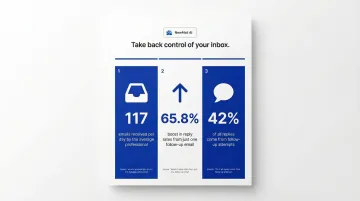
Most of the time, silence isn't rejection — it's inbox overload. The average professional receives 117 emails a day, and yours may have simply slipped through. A well-timed follow-up is not just acceptable; it's often what closes the loop.
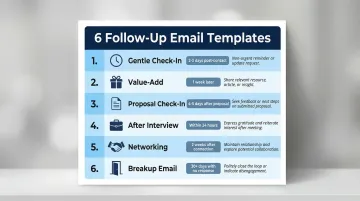
This guide delivers 6 ready-to-use follow-up email samples for different scenarios, plus timing guidance, structure tips, and common mistakes to avoid. Whether you're following up after a proposal, job interview, or networking event, you'll find templates you can customize immediately.
Key Takeaways
- Silence usually signals inbox overload, not disinterest. A well-timed follow-up brings your message back to the top
- Keep follow-ups short (50-150 words), add new value each time, and include one clear call to action
- Wait 3-5 business days before your first follow-up, then space subsequent ones further apart
- Two to three follow-ups is the professional standard; beyond that, response rates drop off sharply
- Subject lines should reference the original topic specifically, not generic phrases like "checking in"
Why Silence Isn't Always a "No"
Inbox Overload Is the Real Culprit
The most common reason emails go unanswered isn't disinterest—it's volume. Professionals receive an average of 117 emails daily, with most messages skimmed in under 60 seconds. Globally, over 424 billion business and consumer emails are forecast to be sent and received daily by 2028. In this environment, even important messages get buried.
The numbers explain why your message likely disappeared without malice:
- 28% of the workweek goes to managing email — nearly 11 hours every week
- Employees get interrupted every 2 minutes by meetings, emails, or notifications
- Most inbox zero efforts last less than a day before the backlog returns
Your unanswered email isn't being ignored — it's competing with dozens of other demands for attention.
The Psychology of Reply Guilt
Recipients often intend to respond but forget. Research identifies an "email urgency bias" where receivers overestimate how quickly senders expect replies, making emails feel more stressful than intended. This creates a cycle: the recipient feels guilty about not responding quickly, which makes the message feel harder to answer, which leads to further delay.
A well-timed follow-up provides a low-friction, face-saving way to re-engage without acknowledging the delay. It removes the psychological barrier and gives the recipient permission to reply as if no time has passed.
Follow-Ups Dramatically Improve Response Rates
Only a fraction of successful conversations happen after the first email. Adding just one follow-up can boost reply rates by 65.8%, according to research analyzing 12 million outreach emails. Separate analysis of over 20 million emails found that follow-ups increase average reply rates from 9% to 13%.
Platform data reveals that 58% of replies arrive on the first email, but the remaining 42% come from follow-up attempts. Sending just one message means walking away before nearly half the conversation even starts. The six templates below show you exactly how to follow up — without sounding pushy or repetitive.
When to Send a Follow-Up Email After No Response
The 3-5-7 Timing Framework
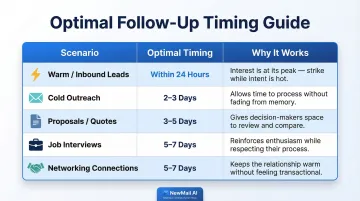
A simple timing rule helps maintain professionalism without appearing pushy:
- First follow-up: 3-5 business days after the original email
- Second follow-up: 5-7 days after the first follow-up
- Final follow-up: 7-10 days after the second
Spacing matters more than volume. Six touches spread over roughly three weeks tends to be the sweet spot — enough persistence to stay visible, not so much that you feel like noise.
Adjusting Timing by Scenario
Different situations warrant different timing:
| Scenario | First Follow-Up | Rationale |
|---|---|---|
| Warm/Inbound leads | Within 24 hours | Sales reps who follow up within a day receive about 25% reply rates |
| Cold outreach | 2-3 days | Too-soon follow-ups signal impatience before trust is established |
| Proposals/quotes | 3-5 days | Allows decision-makers time to review internally |
| Job interviews | 5-7 days | Hiring processes move slowly; too-early follow-ups seem impatient |
| Networking connections | 5-7 days | Lower urgency allows more breathing room |
Best Days and Times to Send
Mid-week mornings consistently yield higher open rates:
- Best days: Tuesday, Wednesday, and Thursday
- Optimal times: 9 AM–12 PM in the recipient's time zone, with peak response windows at 9:30-11:30 AM
These windows aren't arbitrary — mid-week mornings catch recipients before their inboxes fill up and before afternoon meeting blocks take over.
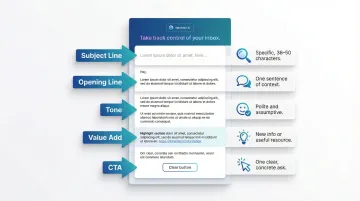
What Every Effective Follow-Up Email Needs
Subject Line: Specific, Not Generic
The best subject lines reference the original topic and make your email instantly recognizable. Research shows that subject lines between 36-50 characters get the best response rates, outperforming short, vague lines by 32.7%.
Good examples:
- "Re: Proposal for [Project Name]"
- "Following up on our conversation from [Date]"
- "Quick follow-up: [Specific Topic]"
Avoid:
- "Just checking in"
- "Touching base"
- "Any updates?"
Personalized subject lines boost response rates by 30.5%, so include specific details that reference your original message.
Opening Line: Provide Immediate Context
Briefly acknowledge the previous email so the recipient doesn't have to search their inbox. Keep this to one sentence—this isn't the place for small talk.
Example: "I wanted to follow up on the proposal I sent last Tuesday regarding your Q2 marketing campaign."
Tone: Polite and Assumptive
Always assume the recipient is busy, not ignoring you. Avoid passive-aggressive phrasing like "as per my last email" or guilt-inducing openers like "I haven't heard back from you." These create defensiveness rather than engagement.
Maintain a professional, helpful tone that makes responding easy and face-saving.
Value or Offer: Add Something New
Each follow-up should include new information—a helpful resource, a clarifying detail, a softer call to action, or a fresh angle. Simply repeating your original message yields diminishing returns.
Ways to add value:
- Share a relevant article or case study
- Offer additional information they might find useful
- Provide a new perspective or insight
- Simplify your original request
Call to Action: Singular and Specific
Using one clear CTA per email can increase click-through rates by up to 371% compared to multiple asks.
Instead of: "Let me know your thoughts or if you'd like to schedule a call."
Use: "Do you have 15 minutes this Thursday at 2 PM for a brief call?"
One concrete ask is always better than multiple options, which create decision paralysis.
If you're sending follow-ups at volume, tools like NewMail AI can help. It drafts context-aware follow-ups in your voice directly inside Gmail, Outlook, or Apple Mail—using the full thread for context, not just the last message. Setup takes 60 seconds, and you never have to start from scratch.
6 Follow-Up Email Samples for After No Response
Each sample below is organized by scenario, with a subject line, body, and breakdown of what makes it work. Customize the bracketed placeholders with your own details.
Sample 1: The Gentle Check-In (First Follow-Up After No Response)
When to use: 3-5 business days after your original email with no reply
Subject: Quick follow-up on [Topic]
Body:
Hi [Name],
I wanted to follow up on the email I sent last [Day] about [specific topic]. I know inboxes get busy, so I wanted to make sure this didn't get lost.
I'm happy to provide more information or answer any questions you might have. Would [specific day/time] work for a brief call to discuss next steps?
Thanks,
[Your Name]
What makes it work: This template is brief, non-accusatory, and assumes good intent. It acknowledges the busy inbox without assigning blame, and the specific call-to-action (suggesting a day/time) makes responding easier than an open-ended question.
Sample 2: The Value-Add Follow-Up (Add Something New)
When to use: Second follow-up when the first received no response
Subject: Re: [Original Topic] + resource you might find useful
Body:
Hi [Name],
I came across [article/case study/resource] this morning and immediately thought of your work on [specific project/challenge]. [One-sentence summary of why it's relevant].
I wanted to share this with you and also circle back on my previous email about [original topic]. If you'd find it helpful, I'm happy to walk through how [your solution/proposal] could address [specific pain point].
Let me know if [day] works for a quick chat.
Best,
[Your Name]
What makes it work: This follow-up earns its place in the inbox by leading with something useful rather than just re-asking the original question. Key reasons it works:
- Justifies the outreach with a resource tied to the recipient's specific work
- Signals you were paying attention — not just running through a sequence
- Gives them a reason to reply even if they're not ready to commit
Sample 3: The Proposal or Quote Check-In
When to use: 5-7 days after sending a proposal or quote
Subject: Following up on the [Project] proposal
Body:
Hi [Name],
I wanted to check in on the proposal I sent over on [date] for [project name]. I'm hoping you've had a chance to review it.
Do you have any questions or need clarification on any of the details? I'm happy to jump on a quick call to walk through the approach and timeline if that would be helpful.
Would [specific day] work for you?
Thanks,
[Your Name]
What makes it work: This template assumes positive intent (they've likely reviewed it) and lowers the barrier to replying by offering to answer questions. It moves the conversation forward with a concrete next step — a call — rather than waiting for a decision. The tone is helpful, not pushy.
Sample 4: The After-Interview Follow-Up
When to use: 5-7 business days after a job interview with no update
Subject: Following up on [Position] interview
Body:
Hi [Interviewer Name],
Thank you again for taking the time to speak with me on [date] about the [Position] role. I really enjoyed our conversation about [specific detail from the interview], and I'm even more excited about the opportunity to contribute to [specific team/project].
I wanted to check in on the status of your hiring process. Please let me know if there's any additional information I can provide.
Looking forward to hearing from you.
Best,
[Your Name]
What makes it work: Referencing a specific detail from the interview shows genuine interest and separates this from a generic follow-up template. It expresses continued enthusiasm without sounding desperate and politely asks for a status update — all while respecting the hiring timeline.
Sample 5: The Networking Connection Follow-Up
When to use: 5-7 days after meeting someone at an event or receiving an introduction
Subject: Great meeting you at [Event]
Body:
Hi [Name],
It was great connecting with you at [event/conference] last week. I really enjoyed our conversation about [specific topic you discussed].
I thought you might find [relevant resource/article] interesting based on what we talked about. I'd also love to continue the conversation—would you be open to a brief call sometime next week?
Let me know what works for you.
Best,
[Your Name]
What makes it work: This template re-establishes the shared context quickly and keeps the tone light and low-pressure, which suits new professional relationships. Sharing a relevant resource shows you were listening and adds concrete value. The casual "sometime next week" framing feels less demanding than a specific time request.
Sample 6: The Final "Breakup" Email (Last Attempt)
When to use: After 2-3 unanswered follow-ups, as your final message
Subject: Closing the loop on [Topic]
Body:
Hi [Name],
I know you're busy, so I'll keep this brief. I haven't heard back on [topic], so I'm assuming now isn't the right time.
I'll close my file for now, but please feel free to reach out if your priorities change. I'd be happy to reconnect down the road.
Best of luck with [specific project/goal],
[Your Name]
What makes it work: "Breakup" emails frequently outperform standard follow-ups — removing pressure often prompts the reply that three earlier attempts couldn't. This one works because:
- Under 80 words: no guilt, no friction
- Gives the recipient a graceful exit rather than forcing a decision
- Well-wishes at the end preserve the relationship for future contact
Follow-Up Email Mistakes to Avoid
Sending Too Many Emails Too Quickly
Back-to-back follow-ups within 24-48 hours signal desperation and can damage professional relationships. Studies suggest the 5th, 6th, or 7th follow-up generates only a fraction of total replies — and sending 4+ emails dramatically increases spam complaint rates.
Professional standard: 2-3 follow-ups per outreach thread, spaced appropriately (3-5 days, then 7 days, then 7-10 days).
One well-crafted follow-up with new value will always outperform three repetitive ones.
Being Vague or Repetitive
A follow-up that simply says "just checking in" with no new information adds zero value. Each email must serve a purpose—new context, new ask, or new offer.
Avoid:
- "Just wanted to touch base"
- "Circling back on this"
- "Any update?"
Instead:
- Reference something specific from your original email
- Share new information or a resource
- Adjust your call-to-action to make it easier to respond
Letting Frustration Show
Passive-aggressive phrasing damages your professional reputation and makes recipients defensive.
Never use:
- "I've tried reaching you multiple times"
- "As per my last email"
- "I'm not sure why I haven't heard back"
- "This is my final attempt to contact you" (unless it genuinely is, in which case use the breakup email format)
Always assume the recipient is busy, not ignoring you. The tone of your follow-up reflects directly on your professionalism, so keep it courteous and charitable.
Frequently Asked Questions
How do you professionally say "gentle reminder"?
Professional alternatives to "gentle reminder" include "Just wanted to follow up on," "Circling back on," or "Wanted to make sure this didn't get buried." These phrases signal the same intent without sounding overly formal or passive-aggressive, and they maintain a helpful, assumptive tone.
What's a good example of a gentle reminder email?
Subject: "Quick follow-up on [Topic]" / Body: "Hi [Name], just wanted to make sure my previous email didn't get lost in your inbox. Happy to answer any questions or provide more detail—let me know what works for you." This format is brief, polite, and makes responding easy.
How many follow-up emails should I send before giving up?
2–3 follow-ups is the professional standard. After three unanswered attempts over 2–3 weeks, close the loop with a brief final note and move on—pushing further risks the relationship without meaningful upside.
What is the best subject line for a follow-up email after no response?
The best subject lines reference the original conversation directly—"Re: Proposal for [Project]" or "Following up from [Date]" outperform vague openers like "Checking in" because they give immediate context and help recipients find the prior thread.
How long should a follow-up email after no response be?
Follow-up emails should be 50–150 words. Short emails are easier to read on mobile, feel less demanding, and often get higher response rates than longer, over-explained messages. Keep your follow-ups concise, focused, and action-oriented.