The gap isn't laziness. It's math. A rep managing 60 active conversations can't manually track response windows, draft timely follow-ups, and still spend meaningful time selling. Something always slips.
This guide covers the practical, measurable benefits that AI email assistants deliver specifically for sales follow-ups — not theoretical efficiency gains, but what actually changes day-to-day when you remove the manual bottleneck from the follow-up process.
Key Takeaways
- AI email assistants close the follow-up gap — more deals touched, fewer left to go cold
- Speed matters more than reps realize: delays beyond minutes, not hours, cost real qualification opportunities
- AI drafts in the rep's own voice, replacing the "just checking in" messages prospects ignore
- Consistency at scale is the compounding advantage — no deal goes quiet because the rep was busy
- Verify that any AI tool processes email content ephemerally, with no storage of sensitive deal data
What Is an AI Email Assistant for Sales Follow-Ups?
An AI email assistant for sales is software that reads the context of ongoing email conversations and either drafts, schedules, or surfaces follow-up messages — without requiring manual input for each interaction.
It operates in the space between first outreach and deal close: the long middle stretch where prospects go quiet, meetings need recaps, and proposals sit unanswered. This is exactly where most pipeline leaks happen — and where an AI assistant earns its place in a sales workflow.
Where It Fits in a Sales Workflow
AI follow-up tools are built around one goal: ensuring no qualified lead goes cold because a follow-up slipped through or landed too late. Specifically, they handle:
- Detecting threads that have gone quiet and surfacing them for action
- Drafting context-aware follow-ups that reference prior conversation history
- Automating timing rules so replies go out within optimal windows
- Extracting action items from meeting threads and surfacing them as next steps
Cold outbound sequencers like Apollo or Outreach are built around initiating contact at scale. AI email assistants for sales follow-up — such as NewMail AI's Nova — are built around keeping existing, warm conversations moving forward. That distinction shapes everything: which metrics improve, which workflows change, and which gaps in your pipeline actually get closed.
The Three Core Advantages of AI Email Assistants for Sales Follow-Ups
Each advantage below ties directly to a measurable sales outcome — specific KPIs that sales managers track, not abstract efficiency claims.
Advantage 1: Speed-to-Follow-Up That Matches Buyer Attention Windows
The timing of a follow-up matters far more than most reps realise.
A 2021 XANT study analysing 55 million sales interactions found that conversion rates were 8x greater when leads were engaged within the first 5 minutes versus waiting anywhere from 5 minutes to 24 hours. Only 0.1% of inbound leads were actually engaged that quickly. The original MIT/InsideSales research put the qualification drop even more starkly: waiting just 30 minutes reduced odds of qualifying a lead by 21x compared to calling within 5 minutes.
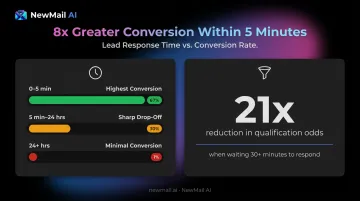
Without AI, the follow-up that should go out within two hours of a meeting ends gets pushed to tomorrow's task list. With AI, the trigger fires immediately — a draft is ready before the rep moves to their next call.
KPIs directly affected:
- Lead-to-opportunity conversion rate
- Time-to-first-response
- Average sales cycle length
When this matters most: High-volume pipelines where reps manage 40+ active conversations simultaneously, and enterprise deals where decision-maker attention is brief and competitive. Whoever responds first sets the frame — follow-up quality rarely compensates for lost timing.
Nova (NewMail AI's assistant) handles this through non-response detection and user-defined timing rules. When a reply window lapses, a context-aware draft surfaces automatically inside Gmail or Outlook — no tab-switching, no separate platform required.
Advantage 2: Personalised Drafts at Scale Without Manual Effort
Generic follow-ups are invisible. "Just checking in" emails get filed with everything else that doesn't require a response.
The alternative — writing a personalised, context-referencing follow-up for every open deal — isn't sustainable. A rep with 50 active prospects can't spend four minutes per email composing messages that reference the specific objection raised in Tuesday's call and the timeline discussed in last week's proposal.
AI email assistants solve this by learning the rep's communication style and generating drafts that reference prior conversation history, match the sender's tone, and reflect the actual context of the deal. The rep reviews, edits where needed, and sends. Per-email effort drops from minutes to seconds across the entire pipeline.
Why this shifts outcomes:
- Salesforce's State of Sales research identified personalised outreach as a top priority tactic among high-performing sales organisations
- 83% of reps using AI for personalisation report it saves time and optimises internal processes, per HubSpot's 2025 State of Sales data
- The dual win: less drafting time plus higher message quality than reps produce under time pressure
KPIs directly affected:
- Open rate, reply rate, positive response rate
- Rep time spent on email composition
Important note on privacy: For sales teams handling sensitive deal information, the AI tool's data architecture matters. NewMail AI processes email content ephemerally — content is analysed in-memory to generate the draft, then discarded immediately. Email data is never stored on NewMail's servers, and Zero Data Retention agreements with AI providers Anthropic and Mistral ensure inputs are discarded after processing, not used for model training.
Advantage 3: Pipeline Completeness Across Every Deal
The most common pipeline leak isn't a bad lead. It's a follow-up that never happened.
A rep managing 80 active conversations manually will apply uneven attention. Some prospects receive multiple timely touches, others receive none, and deal outcomes become partly a function of who the rep happened to remember that week. That's a capacity problem, not a performance one.
AI email assistants act as a systematic layer over the entire pipeline, ensuring consistency at the 80th conversation that the rep delivers to the first.
In practice, this means:
- Stalled threads are flagged automatically before they become cold
- "Waiting" follow-ups are surfaced in a visible queue — prospects who haven't responded to a proposal stay on the radar
- Meeting recaps generate follow-up drafts without requiring the rep to manually reconstruct the conversation
- Every active deal gets the same follow-up cadence, regardless of pipeline volume
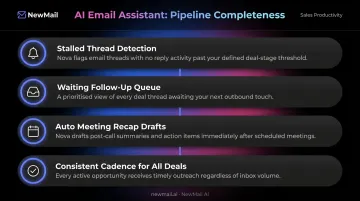
Nova's Conversation Stall Detection feature continuously monitors thread activity. When a conversation that was progressing suddenly goes quiet, it surfaces before the rep would have noticed manually. This shifts the rep's posture from reactive (catching dead deals during a pipeline review) to proactive, flagging them while re-engagement is still viable.
KPIs directly affected:
- Pipeline coverage, deal win rate, follow-up completion rate
- Revenue per rep, number of active opportunities managed
For Enterprise teams, this advantage scales further. NewMail AI's Enterprise plan includes a KPI dashboard tracking adoption, response time, and ROI across teams of 20–200+ users — giving sales managers visibility into whether follow-up workflows are running consistently across the team, not just for their top performers.
What Happens When AI Follow-Up Assistance Is Missing
The consequences of inconsistent follow-up don't announce themselves clearly. Deals go quiet. Prospects choose a competitor. The rep assumes the lead was never serious.
What's actually happening:
- Some prospects get five timely touches; others get two slow ones and then silence — inconsistent cadence creates unequal pipeline treatment.
- Manual tracking breaks down at scale. A rep with 10 deals can keep a mental model of who needs what. At 80 deals, the cognitive load becomes genuinely unmanageable — not a capability problem, a volume one.
- Lost revenue from missed re-engagement doesn't surface in CRM reports. It registers as closed-lost with no attribution to the follow-up that never happened — so the problem stays invisible.
XANT research found that increasing follow-up persistence to at least six call attempts produced 70% more contacts. Most reps don't hit that threshold — not because they don't know it matters, but because they can't sustain it across a large pipeline.
AI follow-up assistance removes the cognitive overhead of tracking and sequencing. That shift — from manually remembering who to follow up with to having the system handle it — is what turns persistence from a best-case scenario into a baseline.
How to Get the Most Value from an AI Email Assistant
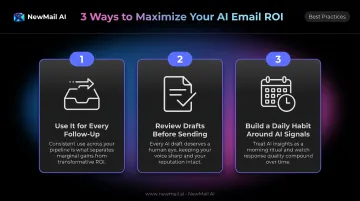
Three principles determine whether a team realizes the full return from AI follow-up tools:
1. Use it for every follow-up, not just the obvious ones. Partial adoption creates blind spots. If the AI is handling 60% of follow-ups and the rep is manually tracking the other 40%, the pipeline consistency advantage disappears. The value compounds when the system is trusted with the whole pipeline.
2. Review drafts rather than auto-sending. The goal is to reduce the effort per email, not remove the rep from the loop. NewMail AI's approval-first model reflects this: every draft surfaces for human review before sending. That checkpoint is what keeps AI-assisted outreach feeling personal, not automated.
3. Build a daily habit around AI-surfaced signals. Follow-up Buckets, stall detection flags, and priority inbox views are only valuable if checked consistently. A brief morning review of AI-surfaced follow-up recommendations — combined with the platform's daily briefing feature — takes minutes and ensures the day starts with the right conversations prioritised.
Frequently Asked Questions
What are the benefits of AI in sales?
AI reduces administrative overhead, accelerates prospect engagement, and ensures more consistent follow-up across a larger pipeline. The measurable outcomes are faster response times, higher pipeline coverage, and improved win rates as more deals receive the follow-up attention they need.
What are the benefits of using email AI?
Email AI reduces drafting time, helps reps prioritise which conversations need immediate attention, and enables personalised communication at scale. Sales professionals managing high volumes of active conversations see fewer dropped deals and faster sales cycles as a direct result.
What are the advantages of a follow-up email?
Follow-up emails maintain buyer attention, signal professionalism and persistence, and account for the majority of closed deals. RAIN Group research shows eight touchpoints are typically needed to convert a new prospect — most deals require follow-up well beyond the first response.
How does an AI email assistant improve sales follow-up response rates?
Response rates improve because AI sends follow-ups within optimal timing windows, drafts them with relevant conversation context rather than generic language, and delivers them consistently — not only when a rep has bandwidth. Each of these factors independently lifts response likelihood, and they reinforce each other in practice.
Can AI email assistants personalise follow-up emails at scale?
Yes. Modern AI email assistants learn communication patterns and pull conversation context to generate drafts that reflect the sender's tone and reference specific prior interactions. This makes personalisation practical across a pipeline of 50 or 100 active prospects, not just a handful of priority deals.
Is it safe to use AI for sales follow-up emails containing sensitive deal information?
Safety depends on the tool's data architecture. Look for assistants that offer ephemeral processing, Zero Data Retention (ZDR) agreements with AI providers, and recognised compliance standards such as GDPR and Google Security Certification. NewMail AI meets all three: ZDR agreements with Anthropic and Mistral, Swiss-based GDPR compliance, and the highest-tier Google Workspace security certification.