Using the wrong tool for the wrong job doesn't just waste budget. It creates more manual work, slows down deals, and leaves hot leads waiting too long for a response.
This article breaks down the real difference between AI email assistants and sales outreach platforms, when each makes sense, and how high-performing teams use both together.
Key Takeaways
- AI email assistants live inside your inbox, helping you respond faster, draft replies in your voice, and manage active conversations
- Sales outreach tools (SEPs) are built for proactive, outbound prospecting at scale
- The two tools solve different problems at different funnel stages and aren't interchangeable
- For teams drowning in inbound replies, an AI email assistant delivers immediate time savings
- For teams building pipeline from scratch, a sales outreach platform is the right starting point
AI Email Assistant vs. Sales Outreach Tool: Quick Comparison
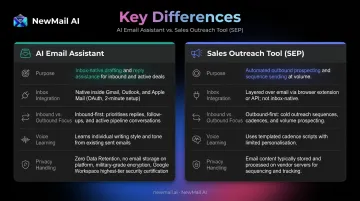
The most important distinction between these tools is directionality: outreach platforms push messages out to new prospects at scale; AI email assistants manage what comes back in. The most important distinction between these tools is directionality: outreach platforms push messages out to new prospects at scale; AI email assistants manage what comes back in. That single difference shapes everything — from where each tool lives to what it costs.
| Dimension | AI Email Assistant | Sales Outreach Tool (SEP) |
|---|---|---|
| Primary Purpose | Manage, draft, and prioritize inbox conversations | Automate cold outreach and prospecting sequences |
| Works Inside Your Inbox | Yes — native to Gmail, Outlook, Apple Mail | No — operates as a separate platform |
| Handles Inbound Sales Replies | Yes — core function | Limited or manual |
| Built for Cold Outreach/Sequences | No | Yes — core function |
| Learns Your Writing Voice | Yes | Rarely |
| Privacy and Data Handling | Varies; privacy-first options exist (e.g., NewMail AI with ZDR) | Data-intensive; often stores and indexes email data |
| Best Fit Use Case | High-volume inbound, active deals, relationship management | Top-of-funnel pipeline generation, SDR sequences |
What Does Each Tool Cost?
Pricing structures are meaningfully different:
- AI email assistants: Shortwave runs $24/seat/month (billed annually); Superhuman is $33/member/month annually. NewMail AI's Professional plan starts at $20/month
- Sales outreach platforms: Instantly's Starter plan begins at $94/month for 5,000 emails; enterprise-tier SEPs like Outreach.io and Salesloft are substantially higher
SEPs command higher prices because they handle more on the outbound side — deliverability management, sequence logic, domain warm-up, CRM syncing. AI email assistants are priced for individual or team inbox augmentation.
What Is an AI Email Assistant?
An AI email assistant integrates directly into your existing email client—Gmail, Outlook, or Apple Mail—and uses AI to help you read, draft, prioritize, and respond to emails faster. No separate platform, no extra tab. It enhances your existing inbox workflow rather than replacing it.
Core Benefits for Sales Teams
According to Salesforce's State of Sales research, sales reps spend only 30% of their time actually selling—the rest goes to admin tasks, deal management, and communication overhead. An AI email assistant directly attacks that gap.
Key benefits for reps:
- Faster replies: AI drafts responses in your tone and voice, ready to review and send in seconds
- Better prioritization: Hot leads, escalations, and time-sensitive requests surface automatically—low-value noise fades
- Nothing missed: Follow-up detection flags threads that need a response before they go cold
- Meeting prep: Thread summaries pull out what was said, what was decided, and what you need to answer before you draft
Key Features to Look For
| Feature | Sales Use Case |
|---|---|
| AI-generated draft replies | Respond to prospects faster without losing your voice |
| Priority inbox with custom categories | Catch hot leads before they go cold |
| Task extraction from threads | Never miss a follow-up commitment after a discovery call |
| Routine response automation | Handle repetitive FAQ-type prospect questions at scale |
| Meeting recap summaries | Send clean follow-ups after demos and calls without starting from scratch |
Privacy: A Critical Consideration
For sales teams in regulated industries—finance, legal, healthcare—the question isn't just whether an AI assistant is useful. It's whether it can be trusted with client correspondence.
Zero Data Retention (ZDR) means email content is processed entirely in-memory and immediately discarded after analysis. Nothing is written to disk. Nothing is retained for model training. For a rep handling sensitive deal terms or confidential client data, ZDR is a compliance requirement, not an optional feature.
NewMail AI is built on this architecture from day one—Swiss-made, GDPR-compliant, and Google's highest-tier Workspace security certified. Formal ZDR agreements with AI providers Anthropic and Mistral contractually guarantee that your client emails are processed ephemerally and never retained. For teams where client confidentiality drives tool selection, that's a verifiable standard, not a marketing claim.
Where AI Email Assistants Fit Best
- Sales teams managing high volumes of inbound replies from multiple campaigns
- Account executives maintaining quality conversations across a large active pipeline
- Customer success teams handling dozens of accounts simultaneously
- Executives managing strategic client relationships
- Any team in a regulated industry where data privacy is a hard compliance requirement
What Is a Sales Outreach Tool?
A Sales Engagement Platform (SEP) is a dedicated platform—separate from your inbox—built to automate multi-step cold outreach sequences, manage prospect lists, and measure campaign performance. Common examples include Outreach.io, Apollo, Instantly, and Salesloft.
Core Benefits for Sales Teams
SEPs solve a fundamentally different problem: generating conversations from cold audiences. According to Woodpecker's analysis of over 20 million cold emails, advanced personalization can push reply rates to 18%, compared to around 9% for basic templates. That performance gap is exactly what SEPs are engineered to close through systematic A/B testing and personalization logic.
What they do well:
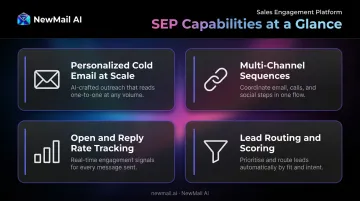
- Send personalized cold emails to hundreds or thousands of prospects automatically
- Run multi-channel sequences combining email, LinkedIn, and call tasks
- Track open and reply rates across campaigns to identify what's working
- Route and score leads based on engagement signals
Key Features That Matter for Outbound
- Sequence builder: Automates timed multi-step follow-ups so every prospect gets a response
- Lead database/CRM integration: Syncs prospect data and records activity without manual entry
- Send-time optimization improves deliverability by reaching each prospect at the right moment
- Deliverability management — domain warm-up and bounce protection — keeps your sender reputation intact
- A/B testing: Tests subject lines and CTAs at scale to improve reply rates systematically
The Key Limitation
SEPs are not designed for inbox management. They don't help you draft replies to incoming messages, prioritize your inbox, summarize long threads, or maintain conversational quality with active clients. Once a prospect replies, the SEP has largely done its job—and the burden of managing that conversation falls back on the rep.
An AI email assistant picks up exactly where the SEP stops: drafting replies, triaging responses, and keeping active conversations moving without adding to the rep's cognitive load.
Where Sales Outreach Tools Fit Best
Despite this limitation, SEPs are the right tool for specific contexts:
- SDR/BDR teams running structured high-volume outbound sequences
- Growth-stage companies building pipeline from a cold audience
- Organizations with dedicated sales ops to manage deliverability, CRM logic, and compliance
- Teams needing systematic A/B testing of messaging and CTAs at scale
AI Email Assistant vs. Sales Outreach: Which Is Right for Your Team?
The decision comes down to four factors:
- Email direction: Is your problem outbound (generating new conversations) or inbound (managing the ones you already have)?
- Funnel stage: Are you filling pipeline or managing active deals?
- Technical capacity: SEPs require ongoing management—sequences, deliverability, CRM syncing. AI email assistants require almost none
- Data privacy requirements: Regulated industries often can't use SEPs safely for ongoing client correspondence
Choose a Sales Outreach Tool If:
- Your primary challenge is generating net-new pipeline from cold audiences
- You need structured SDR sequences running at scale
- You have someone (sales ops or a dedicated SDR manager) to own deliverability, integrations, and campaign analytics
Choose an AI Email Assistant If:
- Reps are overwhelmed managing inbound replies from multiple campaigns and channels
- Response speed is a bottleneck—research shows companies responding within 1 hour are nearly 7x more likely to qualify a lead than those who wait
- You need AI that works inside your existing inbox rather than adding another platform
- You're in a regulated industry where data privacy is non-negotiable
Use Both Together
High-performing sales teams use outreach tools to fill the top of funnel and AI email assistants to manage everything that comes back in.
A practical example: an SDR team runs cold sequences via an SEP like Apollo or Instantly. When a prospect replies, the AE handoff can go two ways:
- Manual: The AE scrambles to piece together context and draft a response from scratch
- AI-assisted: An AI email assistant surfaces the thread, summarizes conversation history, and generates a draft reply in the AE's voice
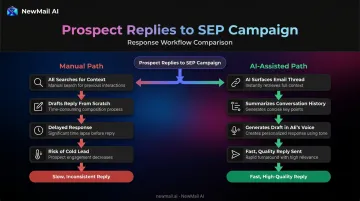
The second path is measurably faster and produces better-quality responses.
NewMail AI fits this second scenario well. It sets up in under 2 minutes inside Gmail or Outlook, learns a rep's voice and communication style during onboarding, and immediately starts surfacing priority threads and generating context-aware drafts. When inbound volume is high (say, after an SEP campaign generates 50 replies in a week) that becomes a serious time multiplier.
Can AI Do Both?
Some platforms (like Lindy or AiSDR) attempt to bridge both categories. The trade-off is real: purpose-built tools consistently outperform hybrid tools in their specific function. An SEP purpose-built for deliverability and sequence automation will outperform a hybrid on outbound; an inbox-native AI assistant purpose-built for drafting and prioritization will outperform a hybrid on inbound. For teams where inbox quality and data privacy are primary concerns, a dedicated AI email assistant is the stronger choice.
Conclusion
The right tool depends on where your email problem actually sits.
Outreach tools handle the front end: starting conversations, booking meetings, filling the pipeline. AI email assistants handle what comes next: managing replies, prioritizing responses, and keeping deals moving once prospects engage. Neither is universally better. The question is which bottleneck is costing you more right now.
For sales teams already running outreach campaigns, the next bottleneck is usually response speed and quality on the inbound side. That's where an AI email assistant like NewMail AI makes a direct difference: reps respond faster, catch hot leads before they go cold, and draft replies in their own voice without losing personal tone. For teams in regulated industries, NewMail AI's Zero Data Retention architecture and Swiss-based infrastructure mean that speed doesn't come at the cost of compliance.
Frequently Asked Questions
What is an AI email assistant for sales?
An AI email assistant lives inside your existing inbox (Gmail, Outlook, Apple Mail) and helps sales teams draft replies, prioritize messages, extract follow-up tasks, and respond faster without switching platforms. It works alongside the rep rather than replacing human judgment in the conversation.
Is AI SDR better than manual SDR?
AI SDRs can outperform manual SDRs on speed and volume for top-of-funnel outbound—Apollo data suggests AI SDRs can send over 3,000 emails per month compared to 75–285 for a human SDR. Manual SDRs still outperform on nuanced, complex conversations. Most high-performing teams use AI for initial outreach and keep humans in the loop for later-stage replies.
What is the 60/40 rule in email marketing?
The 60/40 rule suggests email content should be roughly 60% value or educational and 40% promotional. It's a practical guideline from experienced email marketers, not a formally codified standard, and it helps maintain engagement while reducing spam triggers.
Can I use both an AI email assistant and a sales outreach tool at the same time?
Yes, and many teams do. SEPs generate replies and pipeline from cold outreach; an AI email assistant handles conversation quality and response speed once prospects are engaged. The two tools operate at different stages of the funnel and complement each other.
How is an AI email assistant different from a Sales Engagement Platform?
A Sales Engagement Platform is outbound-first—it sends cold sequences to new prospects from a standalone platform. An AI email assistant is inbox-native and focuses on managing, drafting, and prioritizing the emails already coming in. They solve different problems at different funnel stages and are best used together, not as alternatives.