Introduction
Most reps send one email, hear nothing, and move on — leaving deals on the table that a single follow-up could have saved.
According to Yesware, 70% of sales emails stop after the first attempt — yet a second email after no reply carries a 21% chance of getting a response. Meanwhile, RAIN Group's 2026 research found it takes an average of 8 touchpoints just to secure an initial meeting with a new prospect.
Most reps quit well before reaching that eighth touchpoint. The gap isn't motivation — it's knowing how to follow up without being pushy, generic, or forgettable.
This guide covers the best sales follow-up email templates for 2026, organized by the six scenarios where deals most commonly stall, plus a practical framework for timing, subject lines, and writing follow-ups that actually earn replies.
Key Takeaways
- 70% of sales emails stop after one attempt — the biggest follow-up mistake is simply quitting too early
- Effective follow-up emails are short, specific to the prior conversation, and include exactly one CTA
- Different scenarios (post-demo, no response, post-proposal, re-engagement) require different templates and timing
- Personalized subject lines consistently outperform generic ones like "Following up" or "Touching base"
- AI tools that draft in your own voice let reps follow up faster while maintaining a personal, on-brand tone
What Is a Sales Follow-Up Email and Why Does It Matter in 2026?
A sales follow-up email is a message sent after an initial touchpoint — a cold email, call, demo, or proposal — to continue the conversation, deliver additional value, or prompt a specific next step. The keyword is specific. A follow-up that just "checks in" without context or purpose is not a follow-up; it's noise.
Why Follow-Up Is Harder Now Than It Used to Be
Buyers in 2026 are harder to reach, not because they're less interested in solutions, but because their attention is stretched. Forrester's 2024 State of Business Buying report found that an average of 13 people are now involved in a typical B2B purchasing decision, with 89% of purchases involving two or more departments.
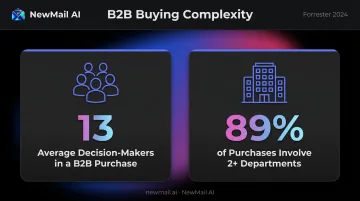
More decision-makers means more internal conversations happening without you in the room, and more chances for your email to get buried while stakeholders align internally.
On the inbox side, Microsoft's 2025 Work Trend Index reported that the average worker receives 117 emails and 153 Teams messages per weekday. Your follow-up is competing with all of it.
The templates below address those six scenarios directly — each chosen because it fits a specific moment in the sales cycle where the right message can restart a stalled deal or accelerate one that's already moving.
Best Sales Follow-Up Email Templates for 2026
Each template below was chosen for a specific scenario where deals commonly stall. The goal is sending the right message at the right moment, not sending more messages.
Post-Demo / Post-Call Check-In
The scenario: Sent within 24 hours of a discovery call or product demo, this is your highest-leverage follow-up. Interest is at its peak, the conversation is fresh, and you have real context to reference.
What makes it work: it names something specific from the conversation — a challenge the prospect raised, a feature that generated a reaction — and proposes one concrete next step rather than leaving things open-ended.
| Element | Detail |
|---|---|
| Subject Line | "Next steps from our call" / "Was the demo what you expected?" |
| When to Send | Within 24 hours of the demo or discovery call |
| Key Element | Reference a specific pain point discussed; include one clear CTA (schedule a follow-up, review a summary doc) |
What to avoid: Recapping the entire demo. One paragraph, one reference to something specific, one ask.
After No Response (1st and 2nd Follow-Up)
Used 3–7 days after an unanswered email or call. The goal here is to reframe, not nudge. Bring something new: a case study, a relevant insight, or a different angle on the problem they mentioned.
This works because it acknowledges the prospect's busy schedule without apologizing, and brings something new to the conversation rather than repeating your last message. Silence is rarely a hard no — it's usually just timing.
| Element | Detail |
|---|---|
| Subject Line | "Thought this might help with [challenge]" / "Different angle on [problem]" |
| When to Send | 3–7 days after the last unanswered message |
| Key Element | Include something new — a resource, a reframe, or a short insight — never resend the same email with "just following up" |
After Sending a Proposal or Pricing Quote
The scenario: Sent 2–3 days after a proposal or quote with no response. This is where more deals stall than anywhere else in the pipeline. The prospect has the information — what they often need is help clearing an internal objection.
What makes it work: it restates the core ROI in one or two sentences, anticipates a common objection (pricing structure, implementation timeline, security requirements), and offers a low-barrier path forward — typically a 15-minute call.
| Element | Detail |
|---|---|
| Subject Line | "Any questions on the proposal?" / "Quick follow-up: [Company Name] quote" |
| When to Send | 2–3 days after sending, then again 5–7 days later if no reply |
| Key Element | Summarize the core benefit in 1–2 sentences; pre-answer one likely objection to lower friction |
Re-Engagement / Cold Lead Revival
Used 30–90 days after a conversation went quiet. The prospect showed genuine interest at some point — they just went dark. This one has to feel personal, not automated.
It works when it opens with a specific trigger rather than "just checking in." A new product feature, a change at their company, or a shift in their industry gives you a genuine reason to reconnect. Explicitly giving the prospect permission to say no increases response rates — that directness signals confidence rather than desperation.
| Element | Detail |
|---|---|
| Subject Line | "New feature to solve [pain point]" / "Things have changed since we last spoke" |
| When to Send | 30–90 days after last conversation, triggered by a new development |
| Key Element | Reference a specific trigger — new feature, industry shift, or prospect's company news — to justify the outreach |
Identifying the right moment to re-engage is the hardest part. Nova, NewMail AI's inbox-native assistant, handles this through its Conversation Stall Detection feature, which automatically surfaces dormant threads that have gone quiet mid-decision so reps can act before the opportunity fully cools.
The Break-Up Email (Final Attempt)
The scenario: Sent after 6–10 unanswered touchpoints across several weeks. You're closing the file — but doing it in a way that invites one last response. This email is not aggressive. It's respectful, honest, and brief.
What makes it work: it creates finality without false urgency, and gives the prospect a guilt-free binary choice — still interested, or not right now. According to a HubSpot practitioner account, one enterprise sales team reported a 33% response rate to well-crafted break-up emails — because the message finally feels human and conclusive.
| Element | Detail |
|---|---|
| Subject Line | "Should I close your file?" / "Last note from me, [First Name]" |
| When to Send | After 6–10 unanswered touchpoints; this is the last message in the sequence |
| Key Element | Keep to 3–4 sentences; offer a clear binary choice (still interested / not right now) |
Done right, the break-up email is often the one that finally gets a reply.
How to Write Follow-Up Emails That Get Replies: Best Practices
Templates give you structure. These principles determine whether they work.
Nail the Timing
The first follow-up should go out within 24 hours of initial contact — that's when context is freshest and interest is highest. Belkins' 2026 analysis of B2B outbound sequences found that follow-up emails (steps 2–6) account for 58.6% of all replies, with step 3 being the single most productive touchpoint for booking meetings.
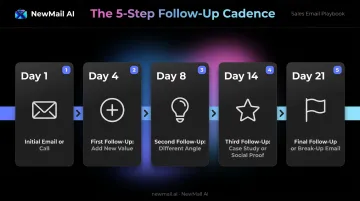
A practical baseline cadence:
- Day 1 — Initial email or call
- Day 4 — First follow-up (add new value)
- Day 8 — Second follow-up (different angle)
- Day 14 — Third follow-up (case study or social proof)
- Day 21 — Final follow-up or break-up email
Write Subject Lines That Earn Opens
Subject lines under 7 words consistently outperform longer ones. Personalization matters more than cleverness. Five formulas that work across scenarios:
- "Quick question about [their challenge]"
- "Thought of you after [relevant trigger]"
- "Following up — [specific topic from last conversation]"
- "One thing I forgot to mention"
- "[Their company name] + [your company name] — next step?"
Avoid "Following up," "Touching base," and "Checking in" — these signal low effort before the email is even opened.
Add Value With Every Touch
Each follow-up should bring something new. RAIN Group found that 69% of buyers are influenced to accept a meeting when a seller shares primary research relevant to their business. Generic nudges don't move the needle.
Effective value-adds to rotate across your sequence:
- A relevant case study from their industry
- A short insight or recent data point tied to their challenge
- A reframed question that surfaces a new angle
- A piece of original research connected to their business goals
Include One Clear, Low-Friction CTA
Every follow-up should end with exactly one ask. Not three options. Not an open-ended "let me know your thoughts." One specific, easy action:
- A yes/no question ("Does Tuesday at 2 PM work?")
- A calendar link
- A single question about their current situation
The lower the friction, the more likely they act.
Use AI Assistance to Draft at Scale Without Losing Personalization
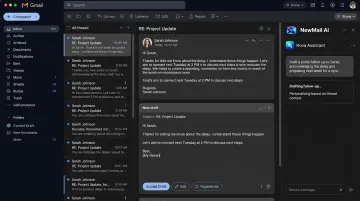
Sales reps running 6–10 touchpoint sequences manually will write worse emails as fatigue sets in. NewMail AI's Nova drafts follow-up emails in your own voice, learning your tone, style, and priorities from a one-time analysis of your sent emails. Personalization no longer requires 30 minutes per message.
Nova also detects unanswered threads automatically and surfaces stalled conversations before they go cold. For teams managing high email volume across active deals, the time savings stack up across every active deal in your pipeline. Setup takes under 2 minutes inside Gmail, Outlook, or Apple Mail, with zero data retention by default.
Common Sales Follow-Up Email Mistakes to Avoid
Sending Generic, Context-Free Messages
Phrases like "just checking in" or "circling back" do one thing: they tell the prospect you have nothing new to say. Every follow-up must reference something specific — the conversation you had, the proposal you sent, the challenge they mentioned. When a prospect sees a vague message, they close it in two seconds and move on.
Following Up Too Quickly or Too Infrequently
Two failure modes exist here:
- Too fast — a second email 12 hours after the first reads as desperation, not diligence
- Too slow — waiting three weeks between touches means the prospect has mentally moved on
The Day 1 / Day 4 / Day 8 / Day 14 / Day 21 cadence above avoids both extremes. Consistent spacing signals professionalism, not pressure.
Missing a Clear Next Step
Closing a follow-up with "let me know your thoughts" leaves the prospect with nothing concrete to do. Every message needs one specific, actionable ask — a meeting, a reply, a click. If the prospect has to figure out what you want from them, most won't bother.
Frequently Asked Questions
What is the 10-3-1 rule in sales?
The 10-3-1 rule is a prospecting ratio framework: for every 10 qualified prospects contacted, approximately 3 will engage in meaningful conversations, and 1 will convert to a client over time. It's used primarily as a pipeline planning benchmark to help reps understand how much outreach volume is needed to hit revenue targets.
What is the 2-2-2 rule in sales?
The 2-2-2 rule, popularized by sales trainer Mark Hunter, is a follow-up timing guideline: follow up 2 days after initial contact, then 2 weeks later, then 2 months later. It maintains consistent touchpoints without overwhelming prospects, and works best as a starting framework rather than a rigid rule for complex B2B deals.
What are the 5 C's of sales?
The 5 C's are commonly defined as: Customer-Centricity, Communication, Closing, Consistency, and Continuous Learning. Follow-up emails directly support at least four: consistent outreach, clear communication, customer-focused messaging, and the persistence needed to close.
How many follow-up emails should you send before giving up?
RAIN Group's 2026 data shows it takes an average of 8 touchpoints to get an initial meeting. Most practitioners recommend ending a sequence with a break-up email after 6–10 unanswered messages — it often generates a reply precisely because it signals closure.
What is the best time to send a sales follow-up email?
Yesware's data points to 1 PM and 11 AM as peak reply windows, with Monday and Tuesday generating the most activity. Belkins' 2026 cold email study similarly found 8 AM–noon strongest for replies. Mid-morning on a weekday beats Friday afternoon by any measure, but matching the recipient's time zone matters more than any universal rule.
How do you personalize a follow-up email without spending hours writing?
Reference one specific detail from your prior conversation — a challenge they named, a goal they mentioned, or a feature that sparked interest. Write in natural language, not formal sales-speak. AI tools like Nova (NewMail AI) can draft follow-ups in your own voice using full thread context, reducing the time per email significantly without sacrificing the personalization that drives replies.