Introduction
Most deals don't die because the prospect lost interest. They die because the salesperson stopped following up.
According to RAIN Group research, it takes an average of 8 touches to get an initial meeting with a new prospect — yet studies suggest 44% of reps give up after just one follow-up attempt. That's where most revenue quietly walks out the door.
The frustration is real: you craft a solid first email, send it off, and then... silence. Do you follow up? When? How do you do it without sounding desperate or pushy?
This guide answers those questions with ready-to-use templates and strategy:
- 10 ready-to-use templates organized by scenario
- Subject line guidance with real examples
- Timing strategy backed by sales email data
- Common mistakes that tank reply rates
- How AI fits into follow-up workflows in 2026
Key Takeaways
- Most deals require 5–8 follow-up touches before closing — one or two rarely cuts it
- Effective follow-ups add new value each time; they don't just repeat the original ask
- Subject lines of 1–5 words outperform longer ones for open rates
- The best follow-up cadence is roughly 6 touches over 3 weeks
- Break-up emails frequently trigger responses from prospects who went quiet
What Is a Sales Follow-Up Email (and Why It Matters)?
A sales follow-up email is any message sent to a prospect after an initial interaction — a cold outreach, a demo call, a pricing quote, a networking event — with the goal of re-engaging, adding value, or advancing the deal toward a decision.
The data is clear: most deals require persistence. Yesware's analysis of sales email sequences found the most reply-successful cadence is 6 touches over roughly 3 weeks, and that response rates stay above 10% through the seventh follow-up. Stopping at one or two attempts means leaving deals on the table, not exercising restraint.
The Difference Between Pushy and Effective
The distinction comes down to whether your follow-up gives the prospect a reason to respond — or just reminds them you exist. Pushy follow-ups typically:
- "Just checking in" with no new information
- Repeating the same pitch from the original email
- Guilt-tripping language like "I've reached out several times now..."
Effective follow-ups do at least one of the following:
- Add a relevant insight, case study, or data point
- Reference something specific to the prospect's situation
- Propose a concrete, easy next step
- Acknowledge where you are in the process honestly
Persistence works when each follow-up gives the prospect a concrete reason to respond. That's the standard every message in your sequence should meet.
10 Sales Follow-Up Email Templates for Every Scenario
These templates are starting points, not scripts. Before sending any of them, personalise the subject line, reference the prospect's specific pain points, and adjust the CTA to fit your sales motion. Sent as-is, they'll land as exactly that.
After No Response (Cold Outreach Follow-Up)
Timing: Send the first follow-up 3–5 days after initial outreach. Reference your original email briefly for context, but don't restate everything.
Template 1 — New Angle
Subject: One thing [Competitor] is doing differently
Hi [Name],
Sent you a note last week about [brief topic]. Didn't want it to get buried.
Quick context that might be relevant: [Company similar to theirs] was dealing with [specific pain point] and reduced [metric] by [result] after [brief solution description].
Worth a 15-minute conversation to see if there's a fit?
[Your name]
Template 2 — Simple Qualifying Question
Subject: Quick question
Hi [Name],
Is [core pain point you solve] something [Company] is actively working on this quarter?
Yes or no works fine.
[Your name]
After a Meeting or Demo
Timing: Send within 24 hours. The conversation is fresh, and referencing specific details from the call signals you were actually listening — and that builds more trust than any polished template.
Template 3 — Full Post-Demo Recap
Subject: Next steps from today's call
Hi [Name],
Thanks for the time today. Quick recap of what we covered:
- Main challenge discussed: [specific pain point they mentioned]
- What resonated: [feature or outcome they responded to]
- Agreed next steps: [whatever was discussed]
I've attached [resource you promised]. Let me know if questions come up as you review it.
Happy to set up a follow-up call for [proposed date] — does that work?
[Your name]
Template 4 — Short Warm Note
Subject: Great talking, [Name]
Hi [Name],
Really enjoyed learning about [specific thing they mentioned — company initiative, challenge, team dynamic].
Based on what you shared, I think [specific aspect of your solution] would make a real difference for [their stated goal].
Would [date/time] work to talk next steps?
[Your name]
After Sending a Quote or Proposal
Timing: Follow up within 2–3 days of sending the quote if you haven't heard back. Addressing pricing concerns directly, rather than sidestepping them, tends to build confidence.
Template 5 — Check-In on the Proposal
Subject: Questions on the proposal?
Hi [Name],
Wanted to check in on the proposal I sent over. Did you get a chance to review it?
Happy to jump on a quick call to walk through any questions — or if something doesn't quite fit your budget or needs, let me know and we can look at options.
[Your name]
Template 6 — Value Reinforcement
Subject: What [Company] typically sees in the first 90 days
Hi [Name],
Following up on the proposal. Before you make a decision, wanted to share what teams similar to yours typically experience after getting started:
- [Outcome 1 — specific and measurable]
- [Outcome 2]
- [Outcome 3]
The investment pays for itself when [specific business outcome]. Happy to talk through the numbers if that's useful.
[Your name]
The Break-Up Email (Final Attempt)
Timing: Use after 4–6 prior attempts with no response. Break-up emails work because they signal closure, and that urgency often prompts a response from prospects who were "too busy." Even a definitive "no" is more valuable than indefinite silence.
Template 7 — Direct and Respectful
Subject: Closing your file
Hi [Name],
I've reached out a few times and haven't heard back, so I'll assume the timing isn't right.
I'll stop reaching out — but if [pain point] becomes a priority down the road, I'm happy to reconnect. I'll leave the door open on my end.
Wishing you well either way.
[Your name]
Template 8 — Light and Conversational
Subject: Should I close your file?
Hi [Name],
Quick one — should I take you off my list, or is this still something worth a conversation?
No hard feelings either way. Just want to make sure I'm not cluttering your inbox if it's not relevant.
[Your name]
Writing Subject Lines That Get Your Follow-Up Emails Opened
Your subject line determines whether the email gets opened at all. Everything else you write is irrelevant if the email sits unread.
Yesware's analysis of over 115 million emails found that subject lines of 1–5 words performed best for open rates. Numbers in subject lines produced 45% higher open rates, and questions produced 10% higher open rates.
Four Subject Line Approaches That Work
| Type | Example |
|---|---|
| Prompt/direct | "Quick question about [topic]" |
| Value-driven | "How [Similar Company] solved [pain point]" |
| Curiosity-based | "Something you might not know about us" |
| Closing/urgency | "Should I close your file?" |
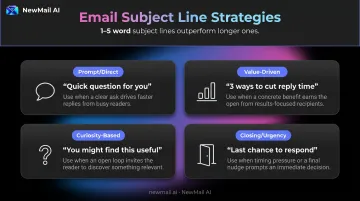
The best subject lines feel written for one person, not broadcast to a list. Small personalisation details move the needle: referencing their company name, a pain point from a previous conversation, or a mutual connection signals that the email was written for them specifically.
What to Avoid
Gong's analysis of over 304,000 follow-up prospecting emails found that "Following up" as a subject line increased raw replies but decreased meeting bookings by 5%. Generic phrases signal low effort and attract low-quality engagement.
Avoid these generic subject lines:
- "Following up"
- "Checking in"
- "Touching base"
- "Just wanted to reach out"
If your email tool supports A/B testing on subject lines, use it. You don't need a large dataset — a few dozen sends will show what resonates with your audience.
Follow-Up Timing: When and How Often to Send
The Recommended Cadence
Yesware's data points to 6 touches over roughly 3 weeks as the most reply-productive cadence. A practical sequence looks like this:
- Day 1 — Initial outreach
- Day 3–5 — First follow-up (new angle or qualifying question)
- Day 7 — Second follow-up (social proof or relevant insight)
- Day 11 — Third follow-up (value reinforcement)
- Day 15 — Fourth follow-up (case study or resource)
- Day 19–22 — Break-up email
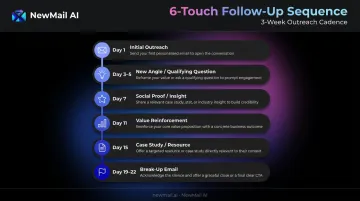
This cadence aligns with the broader expert consensus of 5–8 total attempts before marking a lead cold. Response rates stay above 10% through the seventh follow-up — stopping at attempt two or three is statistically premature.
The 2-2-2 Rule
The 2-2-2 rule — follow up 2 days after contact, 2 weeks later, then 2 months after that — offers a reasonable starting cadence, particularly for longer sales cycles or lower-urgency outreach. Treat it as a useful default, not a rigid formula. Adapt it based on deal size, industry norms, and any engagement signals your email tool surfaces (opens, link clicks, reply patterns).
Best Time to Send
Sales email data from Yesware points to 11 AM and 1 PM as the strongest times for replies. Day-of-week data is less clear-cut, but Tuesday through Thursday consistently performs well across multiple email studies. Use your CRM or email tracking data to verify what works for your specific audience — general benchmarks vary more than they suggest, and engagement signals from AI-assisted tools can surface patterns that manual review misses.
Common Follow-Up Mistakes That Kill Your Reply Rate
Sending Generic, Non-Personalised Emails
Prospects can tell immediately when an email is templated. Gong's research found that the right kind of personalisation can more than double reply rates — but the type matters. Individual-level personalisation (referencing their specific role or challenge) works best for non-managers. Company-level personalisation (recent announcement, industry shift) works better for executive buyers.
Being Too Frequent or Too Aggressive
Following up daily, using guilt-tripping language, or sending walls of text all signal the same thing: you're prioritising your pipeline over their time. Prospects notice — and they stop responding.
Common aggressive patterns to avoid:
- Daily or near-daily follow-ups with no new information
- Guilt-framing like "I've reached out several times without hearing back"
- Long, justification-heavy emails that make the reader do work
Follow-up body length that works: Gong's data found 30–150 words outperformed very short "bubble-up" emails (under 30 words) for booking meetings. Aim for that middle range: enough context to be useful, short enough to respect their time.
Missing a Clear CTA
Every follow-up needs one specific, easy next step. Not three options. Not a vague "let me know your thoughts." One action.
Good CTAs look like:
- "Does Thursday at 2 PM work for a 15-minute call?"
- "Would it help to see a quick demo of [specific feature]?"
- "Yes or no — is this worth exploring this quarter?"
Ambiguous emails are easy to defer. Clear, low-friction asks get answered.
Sending Smarter Follow-Ups with AI in 2026
AI has changed what's practical for sales follow-up. Salesforce reports that 81% of sales teams are experimenting with or have implemented AI, and teams using AI were 1.3x more likely to see revenue growth. The shift isn't just about speed — it's about consistency and personalisation at scale.
What AI Does Well for Follow-Ups
- Drafting personalised follow-ups across dozens of active deals simultaneously
- Suggesting context-aware next messages based on thread history
- Surfacing threads that need attention before they go cold
- Maintaining a consistent tone across a rep's entire pipeline
Where NewMail AI Fits
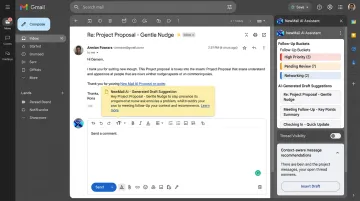
For sales reps managing high email volumes, NewMail AI offers follow-up capabilities built directly into Gmail and Outlook — no separate tab or dashboard required. Nova, NewMail's AI assistant, learns a rep's voice and communication style in about 60 seconds, then drafts follow-ups that sound like the rep wrote them, not like a template generator.
Key capabilities relevant to sales follow-up:
- Sends polite reminders automatically when prospects don't respond, based on timing rules the rep controls
- Recommends what to say next based on full thread context, not generic prompts
- Keeps "waiting" threads visible in Follow-Up Buckets so no deal quietly goes cold
For enterprise sales teams, privacy matters. NewMail processes email content ephemerally with zero data retention by default, and ZDR agreements with Anthropic and Mistral mean client details, deal terms, and competitive intelligence aren't retained after processing. It's Google Workspace security certified at the highest tier, GDPR compliant, and headquartered in Switzerland.
A free 14-day trial (no credit card required) gives sales reps full access to evaluate it before upgrading to the Professional plan.
One Critical Caution
For high-value deals where relationship nuance matters most, always review and customise AI-generated follow-ups before sending. AI removes the volume burden — drafting, reminding, surfacing threads — but the rep's judgment on tone, timing, and depth is what closes deals.
Frequently Asked Questions
What is the 2-2-2 rule in sales?
The 2-2-2 rule is a follow-up cadence where you reach out 2 days after initial contact, again 2 weeks later, and once more 2 months after that. It's a practical framework for staying top-of-mind without overwhelming a prospect — adjust the spacing based on deal stage and how engaged the prospect has been.
How many follow-up emails should you send before giving up?
Most experts recommend 5–8 follow-ups before considering a lead unresponsive. Response rates remain above 10% through the seventh attempt, so giving up early is statistically premature — always close with a well-crafted break-up email.
What should you say in a follow-up email when there's no response?
Acknowledge the silence without blame, briefly restate your value, and close with a single clear question or yes/no ask. Skip the re-introduction, assume they remember you, and get to the point fast.
What is the best time to send a sales follow-up email?
Sales email data points to 11 AM and 1 PM as peak reply times, with Tuesday through Thursday broadly supported across studies. That said, the best time varies by industry and audience — use your CRM or email tracking data to identify what actually works for your specific contacts.
How do you follow up without being annoying?
Add something new with every follow-up — a relevant insight, a useful resource, a direct question. Space your sends appropriately, keep emails short, and always give the prospect an easy way to opt out. Leading with a stat or resource relevant to their role makes each touchpoint feel earned rather than routine.