Introduction
Most B2B deals don't die because of a bad pitch. They die in the silence that follows.
According to RAIN Group's prospecting research, it takes an average of 8 touchpoints to secure an initial meeting with a new prospect — yet most reps quit far earlier. The result? Pipeline that stalls not from lack of interest, but from lack of follow-through.
This article gives you six ready-to-use B2B sales follow-up email templates organized by scenario — after cold outreach, post-demo, post-proposal, post-event, re-engagement, and break-up. Each template includes subject line options and can be personalized and sent within minutes.
Key Takeaways
- Most B2B prospects need 5–8 touches before they respond — spacing and persistence both matter
- Personalizing beyond the first name — company news, role challenges, prior conversations — increases reply rates
- B2B follow-ups involve longer cycles, multiple decision-makers, and higher stakes — which means generic templates will cost you deals
- Every follow-up should add new value — not just remind the prospect you exist
What Makes a B2B Sales Follow-Up Email Different
B2B follow-up is structurally harder than B2C outreach. You're not nudging one person toward a purchase — you're navigating committees.
Gartner's 2025 research surveyed 632 B2B buyers and found that buying groups now range from 5 to 16 people across up to four functions, with 74% of those teams experiencing unhealthy conflict during the decision process. Meanwhile, 6sense's 2025 Buyer Experience Report puts the average buying cycle at 10.1 months. A missed follow-up doesn't just slow one deal; it can stall an entire quarter.
The Anatomy of an Effective B2B Follow-Up
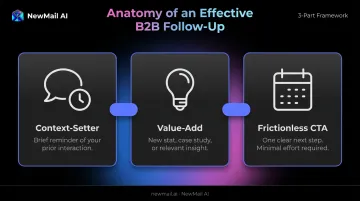
Three elements separate follow-ups that land from ones that get archived:
- Context-setter: A brief line reminding the prospect who you are and what you discussed — without making them dig through their inbox
- Value-add: Something new. A stat, a case study result, an industry insight. Not a rehash of your first email
- Frictionless CTA: One clear next step that requires minimal effort — a yes/no question, a calendar link, or a 15-minute call offer
The biggest mistake reps make is copy-pasting the same email and calling it a follow-up. Each touch needs to move the conversation forward. If you're not adding something new, you're just adding noise.
Tone is part of the value-add. B2B buyers receive dozens of templated emails every week — the ones that get replies feel like they came from a person who did their homework, not a sequence tool on autopilot.
B2B Sales Follow-Up Email Templates for Every Scenario
These six templates cover the most critical moments in a B2B sales cycle. Each uses placeholder brackets — swap them out and send. Match the template to your stage in the deal, and you're ready to go.
Template 1: After No Response to Cold Outreach
When to send: 3–5 business days after initial cold outreach receives no reply
Approach: Shift the angle slightly from your first email. New insight, not repetition. Keep each email under 100 words.
Subject line options:
- "Quick follow-up on [Company]'s [challenge]"
- "One thing I forgot to mention"
Hi [Name],
Following up on my note last week about [specific pain point].
One thing worth sharing: [Similar Company] reduced [relevant metric] by [X%] after addressing exactly this. Took them [timeframe] to see results.
Worth a 15-minute call to see if it applies to [Company]?
If the timing's off, just say the word — happy to close the file.
[Your name]
Template 2: After a Meeting or Demo
When to send: Within 24 hours of the meeting
Approach: This should feel like a helpful summary, not a sales pitch. Recap, confirm next steps, maintain momentum.
Subject line options:
- "Next steps from our conversation"
- "Quick recap from today's call"
Hi [Name],
Great speaking with you today. A quick recap of what we covered:
- Your challenge: [Key pain point discussed]
- How [Product] addresses it: [Specific feature or outcome mentioned]
- What stood out to you: [Note anything they highlighted as interesting]
Agreed next steps: [List what was agreed — e.g., "You'll share this with [Stakeholder] by [date]" or "We'll send over the technical spec sheet"]
If you'd like to schedule a follow-up call with [Stakeholder/your team], here's my calendar: [Link]
Any questions from today — just reply here.
[Your name]
Template 3: After Sending a Proposal or Quote
When to send: 2–3 business days after proposal delivery with no response
Approach: Remove friction, not pressure. Proposals stall because of unanswered questions — address them proactively.
Subject line options:
- "Questions on the [Project] quote?"
- "Checking in on the [Company] proposal"
Hi [Name],
I sent over the proposal on [date] and wanted to check whether anything needs clarifying before you share it internally.
A few things that commonly come up at this stage:
- Pricing: [Brief note on what's negotiable or payment terms available]
- Timeline: [Realistic range and what the rollout involves]
- Security or compliance concerns: [One-line reassurance if relevant to their industry]
Happy to jump on a 20-minute call to walk through any of these — or answer questions over email if that's easier.
[Calendar link]
[Your name]
Template 4: After a Trade Show, Conference, or Networking Event
When to send: Within 48–72 hours of the event
Approach: Reference the actual conversation to prove this isn't a mass blast. Name something they said — a challenge, an opinion, a goal.
Subject line options:
- "Great meeting you at [Event Name]"
- "The [topic you discussed] resource I mentioned"
Hi [Name],
Enjoyed our conversation at [Event Name] — particularly your point about [specific thing they mentioned].
As promised / following up on that: [Attach or link the resource, case study, or insight you discussed].
Given what you're working on with [initiative or challenge], I think there's a real fit worth exploring. Would a 15-minute call next week make sense?
[Calendar link or suggested times]
[Your name]
Template 5: Re-Engaging a Cold or Stalled Prospect
When to send: Several weeks after a prospect went quiet following prior engagement
Approach: Acknowledge the gap without guilt-tripping. Lead with something new and relevant.
Subject line options:
- "Still working on [initiative]?"
- "Something relevant to [Company]'s [challenge]"
Hi [Name],
It's been a while — I wanted to reach out with something that's come up since we last spoke.
[New product feature / industry report / relevant trend that connects to their prior challenge].
I remember [original challenge] was a priority when we talked in [month]. Is that still on your radar, or have things shifted?
If it's still relevant, I'd love to reconnect — [calendar link]. If priorities have changed, no worries at all.
[Your name]
Template 6: The Break-Up Email (Final Attempt)
When to send: After 7–10 unanswered touchpoints — sequences that end here consistently outperform those that don't, because a clear close prompts a response where follow-ups didn't
Keep it under 75 words. Light tone, zero guilt.
Subject line options:
- "Should I close your file?"
- "Closing the loop on [Company]"
Hi [Name],
I've reached out a few times without hearing back — I'm going to assume the timing isn't right and close your file on my end.
If anything changes down the line, you can always reach me at [email] or grab time here: [calendar link].
Wishing you and the [Company] team the best.
[Your name]
Follow-Up Subject Lines That Get B2B Emails Opened
The subject line decides whether the email gets read at all. In B2B inboxes flooded with outreach, generic subject lines are invisible.
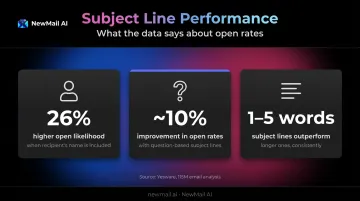
Short, specific, and either question-based or benefit-driven — that's what gets opened. Yesware's analysis of 115 million emails found that including the recipient's name increased open likelihood by 26%, question-based subject lines improved open rates by roughly 10%, and subject lines of 1–5 words consistently outperformed longer ones.
Subject Lines by Scenario
After no response:
- "Quick follow-up on [Company] challenge"
- "One stat worth seeing, [Name]"
- "Still worth a conversation?"
After a demo:
- "Next steps from our conversation"
- "Recap + what comes next"
After a proposal:
- "Questions on the [Project] quote?"
- "Before you share this internally"
Re-engagement:
- "Still working on [initiative]?"
- "[Name] — relevant update for [Company]"
Break-up:
- "Should I close your file?"
- "Closing the loop, [Name]"
3 Subject Line Formulas to Avoid
- "Just checking in" — signals zero new value; gets ignored or deleted
- "Following up" (alone, with no context) — too vague to open; gives the prospect no reason to click
- Misleading subject lines (for example, "Re: Our call" when there was no call) — may inflate opens once, but damages trust and risks spam classification
In B2B sales, one deceptive subject line can close doors across an entire account — the buying committee talks.
The B2B Follow-Up Cadence: How Many Times and When
Most reps stop too soon. RAIN Group's research puts the average at 8 touches needed to reach a prospect — yet nearly half of reps abandon the sequence after just one or two attempts.
A Practical Baseline Sequence
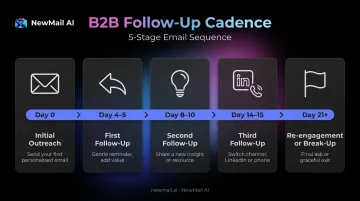
| Day | Action |
|---|---|
| Day 0 | Initial outreach |
| Day 4–5 | First follow-up (same angle, brief) |
| Day 8–10 | Second follow-up (new insight or case study) |
| Day 14–15 | Third follow-up (try a different channel — LinkedIn, phone) |
| Day 21+ | Re-engagement or break-up email |
Vary the Angle, Not Just the Timing
Sending the same message five times isn't a cadence. It's noise that trains prospects to ignore you. Each touch should shift the framing:
- Touch 1–2: Mirror the original pitch angle
- Touch 3–4: New value — a relevant stat, case study, or industry insight
- Touch 5+: Different channel or a direct break-up approach
When to Stop
- Prospect explicitly asks to be removed → honor it immediately, no exceptions
- Opens every email but never replies → treat it as an engagement signal; adjust messaging, change the CTA
- No signal after 8–10 touches → move to long-term nurture, not active follow-up
Best Practices to Boost Your B2B Follow-Up Response Rate
Add New Value with Every Email
"Just following up" is the single most reliable way to get ignored. Every email in a sequence needs a reason to be opened beyond "this person is persistent."
New value can be:
- A relevant case study from a similar company
- A benchmark stat tied to their known challenge
- A product update or feature that addresses something they mentioned
- A brief, actionable tip they can use regardless of whether they buy
Personalize Beyond the First Name
B2B buyers spot templates instantly. Real personalization means referencing something specific to them — not just inserting [Name] into a boilerplate.
Effective personalization triggers for follow-ups:
- A recent LinkedIn post or article they published
- A company funding announcement or leadership change
- Something they mentioned in a prior conversation
- A page visit from their domain (if your CRM tracks this)
One nuance from Gartner's 2025 research: in deals involving multiple stakeholders, personalizing to one person's priorities can actually hurt group consensus. The most effective B2B follow-ups address shared business problems, not just individual preferences.
Make the CTA Frictionless and Singular
Every follow-up should end with one clear next step — not three options, not an open-ended "let me know what you think."
| Weak CTA | Strong CTA |
|---|---|
| "Let me know if you'd like to chat, see a demo, or have any questions." | "Worth a 15-minute call this week? Here's my calendar: [link]" |
| "Feel free to reach out anytime." | "Is Tuesday or Wednesday better for a quick call?" |
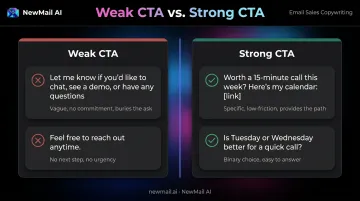
A single yes/no question or a direct calendar link removes decision friction and makes it easy for a busy buyer to act.
Use AI to Draft Faster Without Losing Your Voice
Writing personalized follow-ups from scratch for a full pipeline eats hours every week. That time compounds fast across a live deal list.
NewMail AI's inbox-native assistant, Nova, drafts follow-up emails in the rep's own voice by drawing on the full conversation thread — not just the last message. It runs inside Gmail, Outlook, and Apple Mail with no external dashboards. Every draft is reviewed before anything sends; no email leaves the inbox without human sign-off.
For teams managing active deal pipelines (as opposed to cold outbound sequencing), reps get a first draft in seconds and spend their time on personalization and judgment, not composition.
Track Performance and Iterate
Follow-up email success isn't measured by whether emails were sent — it's measured by open rate, reply rate, and conversion to next step.
Iteration habits to build:
- A/B test subject lines across similar prospect segments
- Track which template in your sequence gets the highest reply rate
- Test send times — Yesware's sales rep data points to late morning (11 AM) and early afternoon (1 PM) as higher-performing windows, with Monday and Tuesday typically outperforming later in the week; validate this against your own CRM data since industry and time zone vary
- Audit underperforming templates quarterly and rewrite them
Follow-Up Mistakes That Stall B2B Deals
Being Too Pushy Too Quickly
Three follow-ups in five days signals desperation, not diligence. In B2B sales — where buying decisions involve multiple stakeholders and months-long cycles — aggressive follow-up damages the relationship before it starts.
The guideline: Space your first two or three follow-ups at least 3–5 business days apart.
Failing to Personalize After the First Email
Many reps write a personalized cold email, then revert to generic templates for every follow-up. That inconsistency signals that the earlier personalization was bait — and it costs you credibility at the moment you have the most context to work with.
Follow-ups are where personalization matters most. By the second or third email, you know what they said in the meeting, what objections came up, and what they care about. Use that:
- Reference a specific concern they raised
- Acknowledge where you are in their evaluation process
- Connect your next ask to something they've already told you
No Clear Next Step
Most follow-up emails get ignored because the prospect doesn't know what they're being asked to do.
Without a single, concrete CTA, even genuinely interested prospects will defer and forget. One CTA per email, always.
Frequently Asked Questions
How many follow-up emails should you send in B2B sales?
The research-backed range is 5–8 touchpoints — RAIN Group benchmarks the average at 8 touches, while top performers average 5. Scale sequence length to deal size and prospect engagement, and always end with a break-up email rather than following up indefinitely.
What is the best time to send a B2B sales follow-up email?
Yesware's data points to 11 AM and 1 PM as higher-performing windows, with Monday and Tuesday outperforming most of the week. Validate timing against your own CRM data, since industry and time zone differences make universal rules unreliable.
What should you write in a follow-up email after no response?
Shift the angle from your original email — share a new insight, reframe the pain point, or reference a result from a similar company. Keep it under 100 words and close with a low-pressure CTA. Re-sending the original pitch with "just checking in" prepended is not a follow-up — it's noise.
How do you write a follow-up email without being annoying?
Space emails at least 3–5 days apart, add something new in every message rather than restating the same pitch, and close the sequence with a clear break-up email. Prospects tolerate persistence; what they don't tolerate is receiving the same pitch on repeat with no end in sight.
How long should a B2B sales follow-up email be?
Generally 75–150 words — shorter than your initial outreach. Brevity signals respect for the prospect's time. The exception is a post-demo recap, which can run longer if it includes a clear summary of discussion points and next steps.
What is the difference between a follow-up email and a cold email?
A cold email is the first contact with someone who has had no prior interaction with you. A follow-up email comes after at least one touchpoint — a meeting, a call, or a previous email — and should reference that context explicitly. Without that reference, you're not following up; you're just sending another cold email.