Introduction
According to Microsoft's 2025 WorkLab research, the average worker receives 117 emails daily — and most get skimmed in under 60 seconds. Your prospecting email is competing against that entire pile, and the subject line is the only thing standing between you and a conversation.
Most reps spend 30 minutes on the perfect email body, then type "Quick question" in the subject field and hit send. The subject line determines whether anyone reads what you wrote — and it deserves the same attention.
This article covers the principles behind high-performing subject lines, 40+ categorized examples you can adapt today, patterns to avoid, and how to test what actually works.
Key Takeaways
- Subject lines are the single biggest driver of open rates — write them first, not last
- The sweet spot is under 9 words and under 50 characters for mobile visibility
- Deep personalization — company news, role context, recent triggers — outperforms first-name-only tactics
- "Checking in," "Quick question," and "Just following up" signal low effort and get ignored
- Reply rate — not open rate — is the metric that actually tells you if a subject line is working
Why Your Sales Prospecting Subject Line Makes or Breaks Your Email
Your subject line controls more than open rates. It shapes whether a prospect ever reads your pitch, replies, or files you as spam — and it affects every email you send afterward.
The Inbox Reality
Prospects receive sales emails constantly. When a subject line reads like a mass send ("Partnership Opportunity," "Touching Base"), that's exactly what it signals. It gets filed alongside every other generic outreach they've ignored this week — and deleted without a second thought.
A specific, well-researched subject line does the opposite. It signals: this was written for me. That's the difference between "Introduction from [Your Name]" and "[Company] + Acme — an idea from [Mutual Contact]."
How Bad Subject Lines Damage Your Sender Reputation
The damage doesn't stop at a single unopened email. Poor subject lines accumulate into a reputation problem. Google's sender guidelines require senders to keep spam complaint rates below 0.10%, with anything above 0.30% triggering inbox placement penalties. Repeated unopened emails and spam flags damage your sender reputation — meaning future emails from your domain are more likely to land in junk, regardless of how good they are.
The subject line is the first line of deliverability defense.
Weak vs. Strong: A Concrete Comparison
| Weak Subject Line | Strong Subject Line |
|---|---|
| "Partnership opportunity" | "[Company] + [Prospect Co] — worth 10 mins?" |
| "Checking in" | "Still thinking about [specific pain point]?" |
| "Introduction" | "[Mutual contact] said I should reach out" |
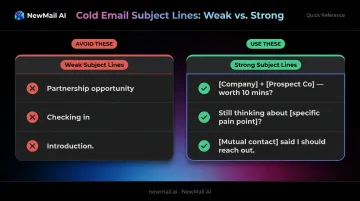
A subject line has one job: earn the open. Save the value proposition for the body.
The Anatomy of a High-Converting Sales Prospecting Subject Line
Five principles separate subject lines that get opened from those that don't.
Keep It Short
Mobile inboxes display roughly 33–50 characters before cutting off, according to Twilio's 2025 guidance. Campaign Monitor recommends a maximum of 9 words and 60 characters, with 7 words cited as a Marketo-derived sweet spot.
Yesware's analysis of 115 million sales emails found open rates peaked for subject lines of 1–5 words. Quick reference:
- Mobile cutoff: ~33–50 characters
- Recommended maximum: 9 words / 60 characters
- Peak open rate range: 1–5 words
If you can say it in fewer words, do.
Lead with Relevance, Not Cleverness
A subject line that's clever but vague performs worse than one that's specific and useful. Anchor on something the prospect actually cares about right now: a business challenge, a company initiative, an industry shift. Generic wordplay that could apply to anyone gets treated like spam, because functionally it is.
Personalize Beyond the First Name
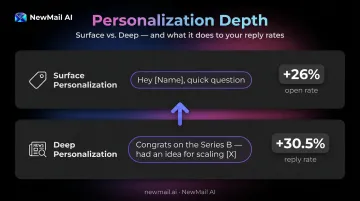
First-name personalization helps. Yesware found emails with a recipient's name in the subject line were 26% more likely to be opened. Name-only personalization is the baseline, not the differentiator.
Deep personalization — referencing a funding round, a LinkedIn post, a recent hire, or a product launch — is what creates genuine relevance. Backlinko's analysis of 12 million outreach emails found personalized subject lines increased response rates by 30.5%.
The difference:
- Surface: "Hey [Name], quick question"
- Deep: "Congrats on the Series B — had an idea for scaling [X]"
Use the Curiosity Gap
George Loewenstein's curiosity research describes this effect precisely: curiosity arises when attention focuses on a gap in one's knowledge. Subject lines that reveal enough to make the prospect feel they need to open the email to close that gap perform well.
Structural patterns that create this:
- Provocative question: "Are you losing deals at the proposal stage?"
- Partial statement: "The reason [Competitor] switched away from [X]..."
- Unexpected juxtaposition: "Why your best reps are your biggest inbox problem"
Skip the Manufactured Urgency
Manufactured urgency ("Act NOW!!") and sensationalist claims erode trust fast in B2B contexts. The subject lines that consistently perform are conversational — they sound like a real person wrote them, not a marketing automation tool.
A simple test: read it aloud as if you were sending it from your personal inbox. If it sounds like a broadcast, rewrite it as a conversation.
40+ Sales Prospecting Email Subject Lines That Get Replies
Subject lines aren't one-size-fits-all. The right line depends on where you are in the sequence and what relationship exists with the prospect.
Cold Outreach Subject Lines
These work for first contact — no prior conversation, no warm intro. Keep them specific and low-pressure.
"Quick question about [specific goal]" — Curiosity-driven and personal. Works because it implies you've done enough research to know what they're working toward.
"[Mutual contact] suggested I reach out" — Social proof immediately lowers the stranger barrier. Always get permission from the mutual contact first.
"Struggling with [X]? You're not alone" — Pain-point-led opener that validates a known challenge. Effective when you've identified a real friction point in their industry.
"[Company] + [Prospect Company] — an idea worth sharing" — Specificity signals this isn't a template blast. Effective for enterprise accounts where relevance is non-negotiable.
"How [Similar Company] fixed their [problem] in 60 days" — Social proof via case study without overselling. Prompts curiosity about the result.
"I noticed you're hiring [X role] — had a thought" — Trigger-event personalization. A job posting is a public signal of a business priority.
"Question about your [specific team/process]" — Shows you've done research without stating it explicitly. Outperforms generic openers consistently.
"What [Industry] leaders are doing differently in 2025" — Positions your email as useful information, not a sales pitch.
"Re: [Prospect Company]'s [recent announcement]" — Note: only use a genuine "Re:" when referencing public news, not to fake a prior conversation.
"An idea for [Company]'s [specific challenge]" — Leads with value delivery. Works best when paired with a concise, useful email body.
"[Name] — your [role] counterpart at [Similar Co] said something interesting" — Combines personalization with social proof and curiosity.
"Honest question: is [pain point] on your radar for Q[X]?" — The word "honest" signals authenticity and invites a genuine reply rather than a delete.
Follow-Up Email Subject Lines
These re-engage prospects who've gone quiet or stalled after initial contact.
"Did I lose you?" — Blunt and unexpected. Triggers guilt and curiosity simultaneously. Works especially well 3–5 days after silence.
"I thought about what you said…" — Implies you've been thinking about their situation specifically, not just running a sequence. Suggests invested attention — and usually prompts a return gesture.
"Still interested in [specific benefit]?" — References the original hook without restating your full pitch. Low pressure.
"One more thing about [previous topic]" — Adds genuine new value rather than just nudging. Only use when you actually have something new to say.
"Quick update on [their initiative]" — Works when you have a real update, a relevant article, or a new case study to share.
"Worth revisiting before [relevant deadline or event]?" — Creates authentic time context without manufactured urgency.
"[Name] — checking on one thing before I move on" — Signals this is near the end of your sequence, prompting a decision.
"Should I close your file?" — The break-up line. Taps the fear of missing something they were already curious about — and often surfaces replies from prospects who were interested but distracted. Use as a final email only.
"Circling back — one specific idea for [Company]" — Better than "following up" because it promises something specific, not just contact for contact's sake.
Meeting Request Subject Lines
These come after initial interest has been established — not as a first cold touch.
"10 mins to discuss [specific initiative]?" — Low-commitment ask tied to a specific topic. Works because it's concrete and brief.
"Want to exchange ideas on [topic]?" — Frames the meeting as a two-way conversation, not a sales presentation.
"[Company] + [Company]: [Date] — does this work?" — Confident and specific. Provides a date, which reduces friction by eliminating the scheduling back-and-forth.
"30 minutes on [pain point] — worth it?" — Gives the prospect an easy way to evaluate the value exchange.
"Can I show you what [Similar Company] did with this?" — Combines social proof with a specific ask. Curiosity drives the open; specificity drives the reply.
"[Name] — when's a good time this week?" — Simple and direct. Best used after a warm exchange where timing is the only remaining friction.
"A quick call about [specific opportunity at their company]" — Research-backed specificity signals preparation, not automation.
Re-Engagement Subject Lines
For prospects who have gone completely silent across multiple touchpoints. Unlike follow-up lines — which re-engage after one or two missed replies — these belong at the end of your full sequence, when you've exhausted standard contact attempts.
"Am I reading this wrong?" — Pattern interrupt. Implies you may have misread their interest level and invites a correction.
"Permission to close your file?" — Honest and respectful. Many prospects reply simply because they appreciate the directness.
"One last thought on [topic]" — Signals genuine finality while delivering one more piece of value.
"Fair enough — but before I go…" — Acknowledges the silence without guilt-tripping. Self-aware without being self-deprecating to the point of undermining trust.
"Still the right time for [Company]?" — Non-pushy check-in that leaves the door open without assuming a yes.
"Genuinely curious — what happened?" — Works in contexts where you had a warm exchange that went cold. Direct curiosity tends to get more replies than a polished final nudge.
Subject Lines to Avoid: Patterns That Kill Your Open Rates
Spam Trigger Words
Kaspersky's 2024 report found spam accounted for 47.27% of global email traffic. Mailbox providers train their filters aggressively. Words and phrases that correlate with spam include:
- "Free," "Guaranteed," "Winner," "Prize"
- "Act now," "Limited time," "Risk-free"
- "Easy money," "Double your income," "Unclaimed"
These aren't automatic spam triggers — context and sender reputation matter — but they increase risk meaningfully.
Overused Sales Phrases
These phrases once worked. They've been used so often that prospects now read them as low effort:
- "Checking in"
- "Just following up"
- "Touching base"
- "Quick question" (when it's not actually quick or specific)
- "I wanted to circle back"
They give the prospect no reason to open — no value hook, no specificity, nothing that shows you did any research before sending.
Clickbait and False Pretenses
Worse than lazy phrases are actively deceptive ones. Using "Re:" or "Fwd:" to imply a prior conversation that doesn't exist destroys trust before the prospect reads a single word — and no body copy recovers from that. Beyond the relationship damage, these tactics drive up spam complaint rates, which damages deliverability for your entire sending domain.
How to Personalize Sales Prospecting Subject Lines at Scale
Personalization improves results. The challenge is doing it across 50–100 daily prospects without spending an hour on research per contact.
The Trigger-Event Framework
The highest-performing personalized subject lines are tied to specific, timely events. Use this pattern:
[Trigger Event] → [Subject Line Angle] → [Example]
| Trigger Event | Subject Line Angle | Example Subject Line |
|---|---|---|
| Series B funding | Scaling a specific function | "Congrats on the Series B — idea for scaling [X]" |
| New executive hire | Transition priorities | "New [CMO/CRO] at [Company] — thought you'd want this" |
| Job posting for specific role | Implied business challenge | "Noticed you're hiring [role] — had a thought" |
| Public product launch | Competitive or operational angle | "[Product launch] + one challenge you might be solving for" |
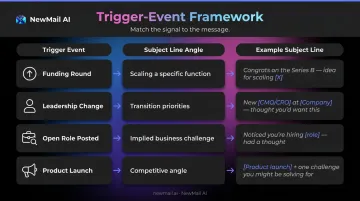
Woodpecker's analysis of 20M+ cold emails found advanced personalization using trigger events and company context produced 17–18% reply rates, compared to 7–9% for basic templates. At that volume, the difference compounds into dozens of additional conversations per month.
Signals Worth Monitoring
- LinkedIn activity (posts, job changes, company updates)
- Funding announcements (Crunchbase, press releases)
- New hires at target accounts (often signals a new initiative)
- Industry news or regulatory changes relevant to their sector
- Competitor moves they'd need to respond to
Where AI-Assisted Drafting Fits
Once a prospect responds, the bottleneck shifts from signal research to keeping up with replies. NewMail AI's Nova learns your voice and communication style, so when you're managing active threads, follow-ups, and inbound replies at volume, your drafts stay consistent and your response time stays fast — without re-templating every message from scratch.
How to Test and Optimize Your Prospecting Subject Lines
A/B Testing Basics
The setup is simple: one variable at a time, equal sample sizes, clean measurement window.
- Write two subject lines for the same email body — change only the subject
- Split your prospect list into two equal segments (same industry, similar seniority)
- Send and wait 48–72 hours before comparing results
- Measure open rate first, then reply rate
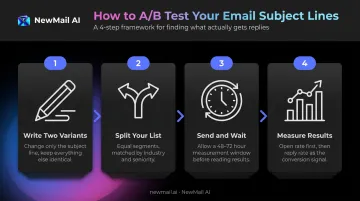
Litmus notes that reliable tests need samples of at least 10,000 people — most outbound teams won't hit that threshold. Treat your results as directional, not definitive. Run 2–3 campaign cycles before drawing conclusions.
What to Do With the Data
Use both metrics as a diagnostic pair:
- High open rate, low reply rate — subject line worked; the email body needs reworking
- Low open rate, decent reply rate — the subject line is the bottleneck, not the message itself
Track both metrics separately, and build a running log of what you test and what you observe. Over time, patterns emerge specific to your industry and prospect type — that log tells you exactly which angles resonate with your specific audience, far more precisely than any universal rule of thumb.
One practical approach: designate one subject line variation per campaign cycle as your hypothesis test. Document the result, update your log, and roll the winner into the next send. Repeat consistently and the compounding effect is significant.
Frequently Asked Questions
What is a good email subject line for sales?
A good sales subject line is short (under 9 words), tied to something specific about the prospect, and creates curiosity or addresses a known pain point. Its only job is to earn the open. Save the pitch for the body.
How long should a sales email subject line be?
Keep it under 9 words and under 50 characters to avoid truncation on mobile devices. Campaign Monitor cites 7 words as a general sweet spot, while Yesware's B2B data suggests opens peak even shorter, at 1–5 words.
What words should I avoid in sales email subject lines?
Avoid spam-associated words like "free," "guaranteed," "act now," and "winner." Also avoid overused filler phrases like "checking in," "quick question," and "just following up." Never use "Re:" or "Fwd:" to fake a prior conversation, as this damages trust and triggers spam filters.
Should I use the prospect's name in the subject line?
Yes — Yesware found name personalization increases open rates by 26%. But a name alone isn't enough. The most effective approach combines the name with a specific, relevant hook tied to their role, company, or a recent event.
How do I know if my subject lines are working?
Open rate tells you whether the subject line earned attention; reply rate tells you whether the email body drove action. Run A/B tests with consistent variables and give each test at least 2–3 campaign cycles before drawing conclusions.
How to write a sales prospecting email?
Start with a subject line tied to something specific about the prospect — their role, company, or a recent trigger event. That specificity sets the tone for a short body (under 150 words) ending in a single, low-friction ask.