Introduction
Most B2B deals don't close after one conversation. According to RAIN Group research, it takes an average of 8 touchpoints to generate an initial meeting with a new prospect — yet most sales reps stop well before that.
The result? Deals lost not because the prospect wasn't interested, but because the follow-up never came.
Poor follow-up is a revenue problem, not a personality one. The solution is following up with purpose — each message adding context, a relevant resource, or a clear next step that moves the deal forward.
This guide covers what separates effective follow-up emails from ignored ones, how to write them, and five ready-to-use templates for the most common sales scenarios.
Key Takeaways
- B2B deals require an average of 8 touchpoints — most reps quit long before that
- Every follow-up should add value, not just repeat the original pitch
- 60% of B2B buyers prefer email when engaging with vendors
- Emails between 75–125 words consistently produce the highest response rates
- One specific, frictionless CTA consistently outperforms vague asks
What Makes a Good Sales Follow-Up Email
Buyers can tell immediately when a follow-up adds something useful versus when it just checks a box. The ones that work treat the email as a continuation of an actual conversation — building on what was said, what was shared, and where the prospect actually is in their decision.
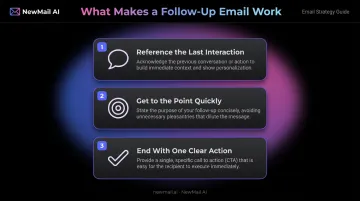
The Three Qualities That Separate Effective Follow-Ups
Reference the last real interaction. A follow-up that ignores what was discussed signals you weren't listening. Name the specific challenge, the decision they're weighing, or the concern they raised.
Get to the point quickly. A two-paragraph email that leads with the ask will outperform one that buries it. Buyers are busy — respect that.
End with one clear action. Not three options, not an open-ended "let me know your thoughts." One next step, stated plainly.
Why Email Works for B2B Follow-Ups
According to the 2024 Demand Gen Report B2B Buyer Survey, 60% of B2B buyers prefer email when engaging with vendors. The same survey found that 57% cited timely vendor response as a primary reason for choosing a winning vendor.
Email works for a few structural reasons:
- Asynchronous by nature — buyers read and respond on their own schedule, without the pressure of a live call
- Easy to search and reference — both sides can pull up the thread at any point in the deal cycle
- Simple to forward internally — when a buying decision involves multiple stakeholders, email travels through the org without friction
How to Write a Sales Follow-Up Email
Start With Context, Not "Just Checking In"
The opener sets the tone for everything that follows. Vague openers like "just following up" or "circling back" tell the prospect nothing and signal minimal effort.
Instead, anchor the conversation immediately:
- "Following our demo on Tuesday, I wanted to share..."
- "Regarding the proposal I sent on [date]..."
- "After our conversation about [specific challenge]..."
This re-establishes shared context in one line and signals that you were paying attention.
Add Something of Genuine Use
Every follow-up should give something before it asks for something. That might be:
- A relevant case study from a similar company
- A concise recap of key benefits discussed
- A direct answer to an objection raised in the last call
- A resource that addresses a pain point they mentioned
This shifts the email from "please respond to me" to "here's something worth your time." The prospect leaves the interaction feeling helped, not pressured.
Personalize Beyond Merge Tags
Templates are starting points, not finished emails. Before sending, insert at least one detail specific to this prospect: their company name in a meaningful context, a challenge they raised by name, or a reference to their role and its particular pressures.
According to a Demand Gen Report on B2B buyer preferences, 58% of buyers accepted outreach because it was highly customized, and 72% chose a winning vendor because the rep demonstrated genuine knowledge of their business. A default template can't deliver that level of specificity.
Write a CTA That Removes Friction
Weak CTA: "Let me know your thoughts." Strong CTA: "Are you available for a 15-minute call Thursday at 10am?"
The difference is specificity. A vague ask puts the cognitive burden on the prospect to figure out what comes next. A specific ask gives them a binary choice: yes or no. That's far easier to respond to.
The subject line plays the same role — it either earns the open or loses it before the email is ever read.
Subject Lines That Signal Continuation
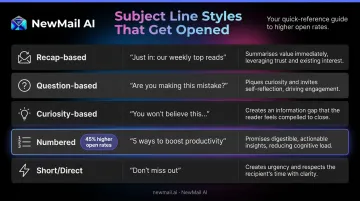
Your subject line should feel like a natural part of the conversation — not a trick or a pressure tactic. Here are five examples across different styles:
| Style | Example | Why It Works |
|---|---|---|
| Recap-based | "Following up on [Company] demo" | Clear context, immediately recognizable |
| Question-based | "Still a fit for [their challenge]?" | Invites a quick reply either way |
| Curiosity-based | "One thing we didn't cover Tuesday" | Creates mild intrigue without being clickbait |
| Numbered | "3 things to move [Company] forward" | Yesware data shows subject lines with numbers get 45% higher open rates |
| Short and direct | "Next steps?" | 1–5 word subject lines consistently produce the highest open rates |
Tools like NewMail AI can draft follow-up emails — including subject lines — directly inside Gmail or Outlook. Its Personalized Drafting Engine learns your tone, style, and product context, so drafts land in your voice without requiring manual rewrites each time.
Sales Follow-Up Email Templates for Every Scenario
The templates below are organized by the most common follow-up situations. Each one is a framework — fill in the specifics before sending. The name, company name, stated challenges, and next step should all be customized to the actual prospect.
After a Demo or Discovery Call
When to use: Within 24 hours of the call, especially if next steps weren't firmly confirmed. The goal is to lock in momentum before it fades.
Subject line options:
- "Quick recap from today's call, [First Name]"
- "Next steps for [Company Name]"
Hi [First Name],
Enjoyed our conversation today — you gave me a clearer picture of where [Company Name] is headed. Based on what you shared, [specific challenge they mentioned] is clearly a priority, and [Product] addresses that directly through [specific feature or approach].
Here's a quick recap of what we covered: [2–3 bullet points or one sentence summary].
Would you be open to a 20-minute follow-up call [Day] at [Time] to walk through next steps?
[Signature]
After Sending a Proposal or Quote
When to use: 2–3 days after sending a proposal with no response. The goal is to confirm receipt, address potential concerns, and make it easy to move forward.
Subject line options:
- "Checking on the proposal — any questions?"
- "[Company Name] proposal — happy to walk through it"
Hi [First Name],
Wanted to make sure the proposal reached you — sometimes these things get buried.
[One-line value reminder: e.g., "The solution we outlined would cut [specific outcome] for your team."]
If you have questions or want to adjust any terms, I'm happy to jump on a quick call. Does [Day/Time] work?
[Signature]
After No Response to Your First Follow-Up
When to use: 5–7 days after the first follow-up goes unanswered. Keep the tone helpful, not frustrated — acknowledge the silence without guilt-tripping.
Subject line options:
- "Thought this might be useful, [First Name]"
- "One resource for [their stated challenge]"
Hi [First Name],
I know things get busy — no worries if my last note got lost.
I came across [relevant resource, article, or case study] that speaks directly to [challenge they mentioned] and thought it might be worth 5 minutes of your time: [link].
If now isn't the right moment, totally understand. Just let me know either way and I'll adjust accordingly.
[Signature]
After Multiple No Responses (The Break-Up Email)
When to use: After 5–8 touchpoints with no reply. The goal is to close the loop gracefully — removing pressure often triggers a response from prospects who felt cornered.
When someone signals they're moving on, it often prompts a reply from prospects who were interested but stalled. HubSpot reports some sales teams see a 33% response rate to break-up emails.
Subject line options:
- "Should I close your file, [First Name]?"
- "Closing the loop"
Hi [First Name],
I don't want to keep filling your inbox if the timing isn't right. I'll take this as my last note for now.
If [specific challenge] ever moves back up the priority list, I'm happy to pick up the conversation.
Wishing you and the team well.
[Signature]
After a Trigger Event or Trial Sign-Up
When to use: When a prospect downloads a resource, signs up for a trial, or engages with previous content. Reach out while their interest is active.
Subject line options:
- "Getting the most out of your [trial/download], [First Name]"
- "Quick tip for [Company Name]"
Hi [First Name],
Saw you [signed up for the trial / downloaded the guide] — great timing.
Most people in [their role or industry] find [specific feature or insight] makes the biggest difference early on, especially if [relevant pain point] is a factor.
Happy to walk you through setup in 15 minutes. Are you free [Day] at [Time]?
[Signature]
Best Practices to Boost Your Follow-Up Reply Rates
Nail the Timing
Timing follow-ups correctly shapes your reply rate more than almost any other variable. Here's a practical guide:
| Trigger | When to Follow Up |
|---|---|
| After a demo or discovery call | Within 24 hours |
| After sending a proposal | 2–3 days with no response |
| After first follow-up goes unanswered | 5–7 days |
| After multiple no responses | After 5–8 total touches |
| After a trigger event (download, sign-up) | Same day or within 24 hours |
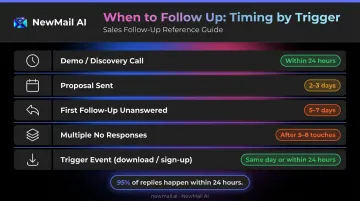
According to Yesware's email timing research, 95% of email replies happen within the first 24 hours. If you haven't heard back in a day, the window for that specific send has largely closed — your next message needs to open with new context, not re-send the same ask.
For send timing, aim for 11am or 1pm on Monday through Wednesday. Friday consistently produces the lowest reply volumes.
Keep It Short and Skimmable
Target 75–125 words per follow-up. That's the range where response rates peak. Long emails bury your ask and give prospects an excuse to defer.
Cut anything that doesn't move the conversation forward:
- No "I hope this finds you well" without substance following it
- No multi-paragraph setups before the actual point
- No restating what you said in the previous email
Use Multi-Channel Follow-Up Selectively
Brevity on its own only goes so far. If email isn't getting a response, coordinating across LinkedIn and phone can increase reach — but the key word is coordinated, not simultaneous.
A thoughtful sequence might look like this: send a follow-up email on Day 1, connect on LinkedIn with a short personalized note on Day 3, and make a brief call on Day 5 that references both. Each touch reinforces the others without feeling like a campaign.
What doesn't work: hitting someone across every channel with the same message on the same day. That's saturation, not strategy.
Common Sales Follow-Up Email Mistakes to Avoid
Starting Without Context
| Example | |
|---|---|
| Weak | "Just following up on my last email." |
| Strong | "Following our call last Thursday where you mentioned [specific challenge], I wanted to share..." |
The weak version tells the prospect nothing. The strong version re-anchors the conversation and signals genuine attention in one sentence.
Using the Same Template Every Time
Sending identical messages across multiple follow-ups means prospects learn to ignore them. Each follow-up should either shift the angle, add a new piece of value, or escalate the ask.
A strategic three-touch sequence might look like this:
- Touch 1: Recap the conversation and propose a next step
- Touch 2: Add a new resource or case study relevant to their situation
- Touch 3: Address a likely objection directly and make it easy to respond either way
Each one moves the conversation forward. None of them repeat what the previous one already said.
Making the CTA Too Vague or Too Complex
"Let me know if you're interested" puts the entire burden on the prospect — no clear next step, no timing, no easy way to say yes.
Every follow-up needs a single, specific, easy-to-act-on CTA. One ask, one clear path forward.
Frequently Asked Questions
How many follow-up emails should you send before giving up?
RAIN Group data shows B2B deals typically need around 8 touchpoints before generating an initial meeting — so most reps give up too early. Aim for 5–8 follow-ups total, ending with a break-up email as your final touch. After that, let the prospect re-engage on their own terms.
What should you say in a follow-up email after no response?
Acknowledge the silence without guilt-tripping ("I know things get busy"), add something new and useful — a resource, an insight, or a relevant case study — and keep the tone genuinely helpful. Don't repeat your original pitch word for word. A new angle gives them a reason to reply.
How do you write a follow-up email that doesn't sound pushy?
Lead with value before making an ask. Skip manufactured urgency phrases like "this offer expires soon" unless they're genuinely true. Giving the prospect an easy out ("if timing isn't right, just let me know") and meaning it consistently gets more replies than pressure tactics.
What is the best time to send a sales follow-up email?
Mid-week (Tuesday through Thursday) between 11am and 1pm tends to generate the highest reply volumes, based on Yesware's sales email data. Testing against your specific audience and deal type will always outperform any universal benchmark.
How long should a sales follow-up email be?
Target 75–125 words. Emails in this range consistently produce the highest response rates because they're easy to read and have a clear point. Brevity signals respect for the prospect's time — and keeps the message focused on one action.
What makes a good subject line for a follow-up email?
Relevance beats cleverness. The best follow-up subject lines signal continuity with the prior conversation, stay under five words when possible, and avoid spam triggers like all-caps or excessive punctuation. "Quick recap from Tuesday" will outperform "Don't miss out on this opportunity" in nearly every scenario.