A poor sales-to-CS handoff is one of the most common causes of early customer frustration, yet it's almost entirely preventable. Salesforce research found that 65% of customers report having to repeat or re-explain information to different representatives — and that experience erodes trust faster than almost any product issue could.
This guide covers exactly what to include in a handoff email, three ready-to-use templates for different scenarios, and the practical tips that separate a forgettable handoff from one that builds real confidence.
Key Takeaways
- Send the handoff email within 24 hours of close — ideally the same day
- Always confirm that notes and goals have already been shared before the CSM reaches out
- Write subject lines that introduce the person, not announce a process
- Never skip the internal handoff note — it directly shapes every customer-facing message that follows
- Match the email's tone to how you've been communicating with this customer throughout the deal
What Is the Sales to Customer Success Handoff (and Why It Matters)
The sales-to-CS handoff is the moment ownership of the customer relationship officially transfers from the sales rep to the customer success manager. From the customer's perspective, it's their first post-sale experience — and first impressions in this phase are just as critical as they were before the contract was signed.
Three business outcomes hinge on getting this transition right:
- Early churn prevention — Customers who feel disorganized treatment after signing are far more likely to disengage before they've seen real value
- Trust continuity — The rapport built during sales doesn't automatically transfer; the handoff email is often what carries it across
- CSM context — A CSM starting from zero has to spend their first interaction gathering information the sales rep already collected, which wastes everyone's time
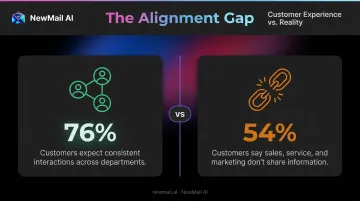
The numbers reflect how often this goes wrong. Salesforce research shows 76% of customers expect consistent interactions across departments — yet 54% say it generally feels like sales, service, and marketing don't share information. A well-structured handoff email is the simplest way to close that gap before the customer notices it exists.
What to Include in a Sales to CS Handoff Email
Two Types of Handoff Emails
There are actually two distinct emails in a proper handoff:
- The external email — sent to the customer, introducing their new CSM
- The internal note — sent from the sales rep to the CSM before any customer contact
Most templates focus only on the external email. Both matter equally.
The Four Non-Negotiables (Customer-Facing Email)
Every customer-facing handoff email needs these elements:
A warm, personalized greeting that references something specific about the customer or their situation
A clear introduction of the CSM by full name, role, and what they'll specifically help with
Confirmation that context has been shared — signals the customer won't need to repeat themselves
A defined next step — a scheduling link, a specific timeframe for outreach, or both
Confirmation that context has been shared — signals the customer won't need to repeat themselves
The phrase "I've already shared our notes with [CSM Name]" is one of the most confidence-building lines you can write. It signals organizational alignment and tells the customer the transition is already in motion.
What the Internal Note Must Cover
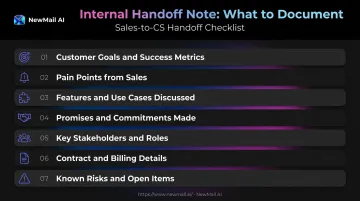
The internal handoff note is what makes the external email possible. Without it, the CSM is improvising. It should document:
- Customer's primary goals and success metrics
- Pain points surfaced during the sales process
- Features or use cases discussed
- Promises made (discounts, timelines, custom configurations)
- Key stakeholders and their roles
- Contract and billing details
- Known risks or unresolved objections
ChurnZero recommends documenting stakeholder sentiment, desired product outcomes, target go-live dates, and outstanding tasks — going well beyond the basics. This note is the source of truth that powers everything that follows.
Tone and Subject Line
Match the tone of your previous communication with this customer. A formal enterprise buyer expects precision; a startup founder you've been texting with expects warmth. Neither should feel like they're suddenly dealing with a different company.
For subject lines, make them relationship-forward rather than transactional:
- "Introducing [CSM Name] — your guide to getting started with [Product]"
- "[Customer Name], meet the person who will help you hit the ground running"
- "[First Name], here's what happens next"
Writing personalized versions of each email gets harder as your account load grows. Nova, NewMail AI's inbox-native assistant, drafts subject lines and body copy in your own voice by drawing on your full email thread for context — so each handoff still feels individual, even when you're managing a wave of new accounts.
Sales to Customer Success Handoff Email Templates
Template 1: Sales Rep Introduction Email (Customer-Facing)
Use this when the sales rep sends the first post-close email introducing the CSM.
Subject: Introducing [CSM First Name] — your guide to getting started with [Product Name]
Hi [Customer First Name],
We're genuinely glad to have [Company Name] on board — and now the real work begins: making sure we deliver on everything we discussed.
I'm handing the baton to [CSM Full Name], who will be your dedicated point of contact going forward. [CSM First Name] specializes in helping teams like yours [specific use case or goal discussed during sales, e.g., "cut onboarding time for new hires using our workflow automation features"].
I've already passed along our full conversation history, your goals, and the specific outcomes you mentioned wanting to see in the first 90 days — so you won't need to re-explain anything.
[CSM First Name] will be reaching out within [timeframe, e.g., one business day] to schedule your kickoff call. If you'd prefer to book directly, here's their calendar: [Scheduling Link]
It's been great working with you, and I'm still available if anything comes up on my end.
Warmly, [Sales Rep Name] [Title] | [Company] [Contact Info]
Formal/Enterprise Variant:
Subject: Transition of Account Management — Introduction of Your Customer Success Manager
Dear [Customer Title and Last Name],
As we move into the post-signature phase of our engagement, I'd like to formally introduce [CSM Full Name], who will serve as your primary Customer Success Manager at [Company Name].
[CSM First Name] brings extensive experience working with organizations of your size and complexity, particularly in [relevant use case]. I have provided [him/her/them] with a comprehensive briefing that includes your strategic objectives, implementation priorities, and any open items from our conversations.
[CSM Full Name] will contact you directly within [X] business days to schedule an initial alignment call. If your schedule requires an earlier date, please use the link below to select a time that works: [Scheduling Link]
Thank you for your confidence in [Company Name]. I look forward to seeing your team achieve the outcomes we discussed.
Regards, [Sales Rep Name] [Title] | [Company] [Contact Info]
Template 2: CSM Self-Introduction Email
Use this when the CSM is initiating first contact directly — either because the sales rep has already sent a heads-up, or because the CSM is handling the introduction independently.
Subject: Hi [First Name] — I'm [CSM Name], and I'm here to help you get started
Hi [Customer First Name],
[Sales Rep Name] has given me a thorough rundown — your goals around [specific goal], the timeline you're working toward, and what a successful outcome looks like for your team. So while we haven't spoken directly yet, I already have a solid foundation to work from.
My name is [CSM Full Name] and I'll be your point of contact at [Company] from here on. My focus is making sure you see real value from [Product] — not just getting configured, but ensuring the setup actually maps to what you're trying to accomplish.
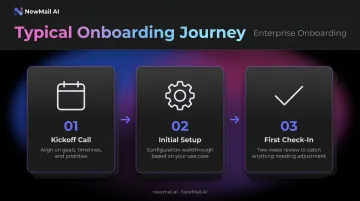
Here's what onboarding typically looks like for teams in your situation:
- Kickoff call — we align on goals, timelines, and any immediate priorities
- Initial setup — I'll walk your team through configuration based on your specific use case
- First check-in — usually at the two-week mark, to catch anything that needs adjusting
Would love to get our kickoff call on the calendar. Here's my scheduling link: [Link]
Looking forward to working with you.
[CSM Full Name] Customer Success | [Company] [Contact Info]
Template 3: Internal Handoff Note (Sales Rep to CSM)
Complete this before sending the external email. The quality of Template 1 and 2 depends entirely on this.
INTERNAL HANDOFF NOTE — [Customer Company Name] Completed by: [Sales Rep Name] | Date: [Date] | Account Owner: [CSM Name]
Customer Overview
- Company name:
- Primary contact name and title:
- Additional stakeholders (names, roles, influence level):
Goals and Success Metrics
- Primary business outcome they're trying to achieve:
- How they'll measure success (use the customer's exact words here — not your interpretation):
- Timeline expectations:
Pain Points Surfaced During Sales
- What problem were they solving when they found us?
- What had they tried before that didn't work?
- Any competitive context?
Product Scope
- Features/use cases discussed:
- What they are specifically NOT using (at least initially):
- Any custom configuration or integration requirements:
Promises and Commitments Made
- Pricing exceptions or discounts applied:
- Feature requests noted or escalated:
- Timeline commitments made: (List anything said verbally, not just what's in the contract)
Known Risks or Open Items
- Any objections not fully resolved?
- Internal champions vs. skeptics?
- Anything to watch for in the first 30 days?
Contract Details
- Contract value and billing cycle:
- Renewal date:
- Any special contract terms?
Recommended First Move What should the CSM prioritize in the first call or email?
Tips for Writing a Handoff Email That Actually Works
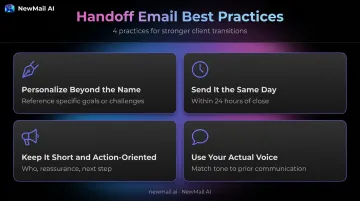
Personalize beyond the name field. Reference something specific — a goal they mentioned, an industry challenge they're navigating, or a detail from a conversation. A generic handoff email signals a generic experience ahead. Salesforce found that 85% of business buyers expect companies to demonstrate a firm understanding of their business — that expectation doesn't disappear after they sign.
Keep it short and action-oriented. The customer needs three things: who their new contact is, confirmation they're in good hands, and what to do next. Everything beyond that risks losing them before they reach the scheduling link.
Send it the same day. The handoff email should go out within 24 hours of close — ideally within hours. Delays create uncertainty and let the momentum from the sales process evaporate. The customer has just made a financial decision; even brief radio silence can feel like buyer's remorse fuel.
Use your actual voice. If you've been texting this customer GIFs, don't send them a formal three-paragraph email. Consistency in communication style is itself a form of trust.
Nova's tone controls and thread-context features can help here. Because Nova builds drafts from your full conversation history rather than a blank page, you're starting from something contextually accurate — not rewriting the same email for the fifth account this week.
Common Mistakes to Avoid
Most handoff failures aren't caused by bad intentions — they come from small oversights that erode trust at exactly the wrong moment. Here are the four most common ones:
Re-selling after the close. The handoff email is not the place for upsell language, product hype, or feature recaps. They've already bought. Focus entirely on service continuity and what happens next.
Leaving ownership ambiguous. The email must make absolutely clear who the customer's new contact is. "Our team will be in touch" is not a handoff — it's a gap in coverage waiting to happen.
Skipping the internal note. If the CSM receives no context before their first call, they'll spend it gathering information the customer already provided in sales. 54% of customers already feel that repeating themselves is the norm — don't confirm that expectation on day one.
Waiting too long. A handoff email sent three days after closing feels like an afterthought. By that point, the customer has had time to wonder what happens next, and that uncertainty is never productive.
Frequently Asked Questions
What is the sales to customer success handoff?
It's the formal transfer of customer ownership from sales to customer success, typically the moment a deal closes. The CSM should start with full context — so the customer never has to repeat themselves or feel like they're starting over.
How do you write a handover email to a customer?
Keep it personal, brief, and action-oriented. Introduce the new point of contact by name and role, confirm that context has already been shared, and give the customer one clear next step — ideally a scheduling link. Match the tone to how you've communicated throughout the deal.
What information should be included in a sales to CS handoff email?
The customer-facing email needs the CSM's name and role, reassurance that context has been passed on, and a defined next step. The internal note that drives it should cover goals, pain points, promises made, stakeholder details, and contract specifics.
When should the sales to CS handoff email be sent?
Within 24 hours of the deal closing, ideally the same day. Delays erode the momentum built during the sales process. Leaving the customer uncertain about what comes next is a poor way to begin an onboarding relationship.
What should the subject line of a handoff email say?
Make it relationship-forward, not transactional. Options like "Introducing [CSM Name] — your guide to getting started" or "[Name], meet the person who will help you hit the ground running" work well. Avoid anything that sounds like an internal process announcement.